
COSHH assessment for water treatment chemicals: UK guide
- Jul 26
- 7 min read

A COSHH assessment for water treatment chemicals is the formal process by which UK organisations evaluate risks from hazardous substances and put controls in place to protect workers. Under the Control of Substances Hazardous to Health Regulations 2002, every employer using hazardous chemicals must carry out and document this assessment. There is no opt-out, regardless of organisation size or sector.
Water treatment chemicals sit firmly within scope. Biocides, scale inhibitors, pH adjusters, and disinfectants all carry health hazards ranging from skin irritation to respiratory sensitisation. A compliant assessment must cover the hazards present, who is exposed, what controls are in place, how emergencies are handled, and how chemicals are disposed of. Safety Data Sheets (SDS) and product labels are your primary hazard sources for each substance.
A compliant COSHH assessment for water treatment chemicals must include:
Identity and classification of each chemical in use
Who is exposed and under what circumstances
Exposure pathways: inhalation, skin contact, and ingestion
Existing and proposed control measures
Emergency procedures and spill response
Safe disposal routes
Review dates and responsible persons
Bespokecompliancesolutions works with commercial and public sector clients across the UK to build these assessments into practical, auditable compliance programmes rather than leaving them as documents that gather dust.
Table of Contents
How do you identify hazards and assess exposure risks from water treatment chemicals?
Why does local exhaust ventilation need its own compliance schedule?
How does COSHH fit into your Legionella compliance programme?
Specific exposure monitoring techniques for water treatment chemicals
Bespokecompliancesolutions: practical COSHH and Legionella compliance support
How do you identify hazards and assess exposure risks from water treatment chemicals?
Start with the SDS for every chemical on site. Section 2 gives classification and hazard statements; Section 8 gives occupational exposure limits and recommended controls. Product labels add a quick visual reference, but the SDS is the authoritative source.
Common hazards in water treatment include:
Irritants and corrosives: chlorine-based disinfectants, acids used for pH correction
Sensitisers: isothiazolinone biocides, which can trigger occupational asthma
Carcinogens and reproductive hazards: hydrazine, used in some oxygen scavengers
Acute toxicity: high-concentration glutaraldehyde and formaldehyde in certain biocide formulations
Exposure pathways matter as much as the chemical classification. Inhalation is the primary route during dosing operations and tank cleaning. Skin contact is the dominant risk when changing chemical containers or clearing blockages. Ingestion is less common but relevant in poorly controlled environments.
Risk factors to assess for each task:
Frequency and duration of exposure
Quantity of chemical handled per task
Whether the task is routine or occasional
Presence of vulnerable workers (those with asthma, skin conditions, or pregnancy)
Adequacy of existing ventilation
Whether the task is performed in a confined space
Pro Tip: The HSE advises avoiding products containing formaldehyde, glutaraldehyde, or hydrazine wherever possible. If substitution is not feasible, minimise concentration and duration of use. Choosing tablet or granule forms over liquids and powders also reduces inhalation and skin contact risks significantly.
COSHH assessment is not a paperwork exercise — it requires you to understand real exposure scenarios before deciding whether controls are adequate.
What must you document and which controls actually work?
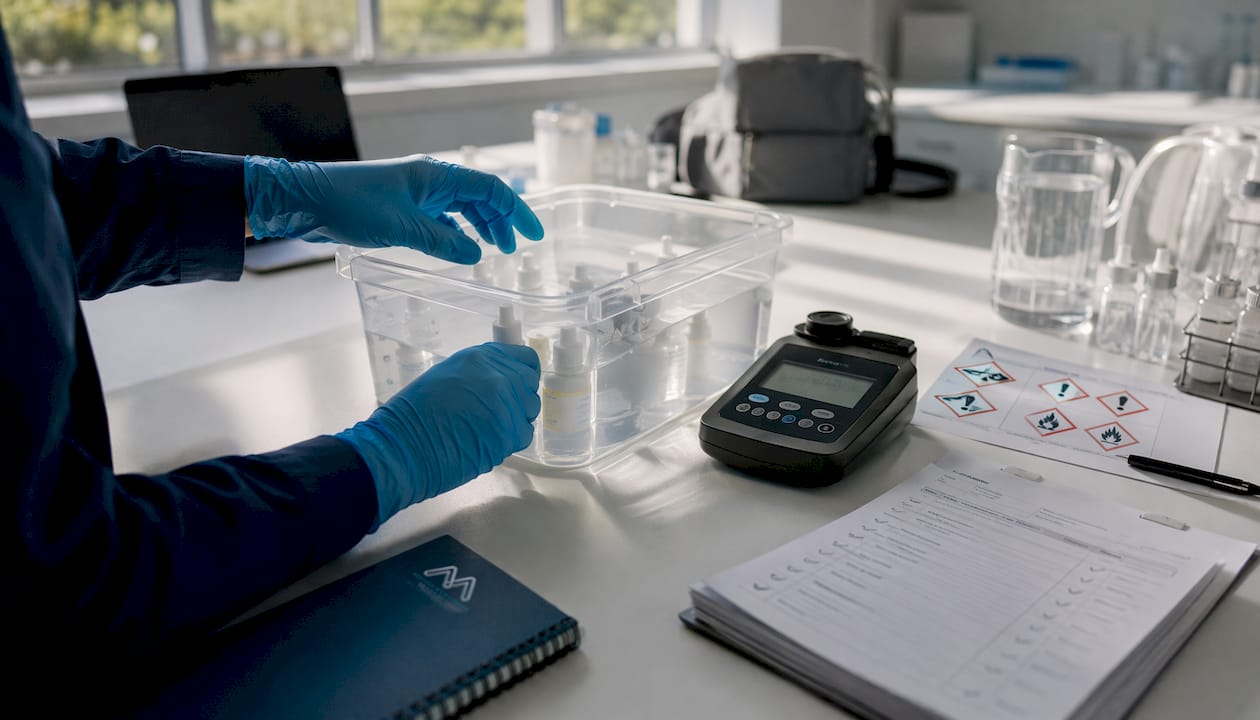
Every assessment must be written down and cover: the chemical and its hazards, the tasks and workers exposed, the controls in place, emergency and first-aid procedures, and disposal methods. Verbal agreements and informal arrangements do not satisfy the Regulations.
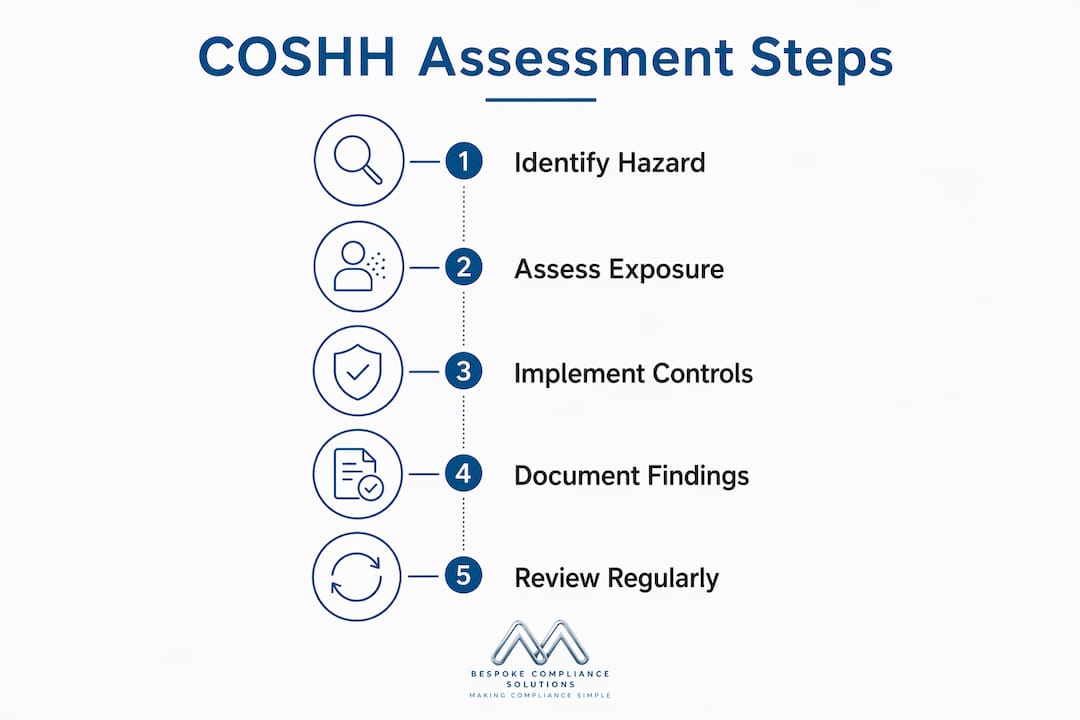
The control hierarchy runs in this order: elimination, substitution, engineering controls, administrative controls, and finally PPE. PPE is the last resort, not the first response.
Practical controls for water treatment settings typically include:
Closed dosing systems that prevent operator contact with concentrated chemicals
Secondary containment for all chemical storage: bunded areas or drip trays capable of holding 110% of the largest container volume
Physical segregation of incompatible chemicals (acids from alkalis, oxidising from reducing biocides)
Designated decanting areas with spill kits immediately accessible
Appropriate RPE where inhalation risks cannot be engineered out, with fit testing for tight-fitting masks
Health surveillance for workers regularly exposed to skin or inhalation sensitisers
Assessments must be reviewed whenever there is a significant change: a new chemical, a new task, a near-miss, or at least annually as good practice. Record-keeping is not optional. A documented audit trail is what demonstrates due diligence to the HSE or a local authority inspector. Staff must be informed of the hazards they face and trained in the controls relevant to their work. Training records belong in the same compliance file as the assessments themselves. For a structured approach to documenting chemical hazards within your wider water hygiene programme, the water hygiene risk register guidance from Bespokecompliancesolutions is a practical starting point.
Why does local exhaust ventilation need its own compliance schedule?
Local exhaust ventilation (LEV) captures airborne contaminants at source before they reach the worker’s breathing zone. For water treatment operations involving chemical dosing, tank venting, or confined-space access, LEV is often the difference between an acceptable exposure level and a health risk.
The legal requirement is clear: LEV must be examined and tested at least every 14 months by a competent person, and more frequently where the risk is higher. The test report must be kept for at least five years.
LEV maintenance and testing best practices:
Pre-use visual checks by operators (damaged ductwork, blocked hoods, unusual noise)
Quarterly performance checks by a competent in-house person
Statutory thorough examination every 14 months maximum, with a written report
Immediate investigation and repair if airflow falls below design specification
Records of all checks, repairs, and examinations retained on site
An LEV system that has not been tested is legally non-compliant, even if it appears to be working. Inspectors will ask for the examination report. If it cannot be produced, the absence itself becomes an enforcement issue. Integrating the LEV schedule into your broader water hygiene risk hierarchy controls keeps all engineering controls under a single review cycle.
How does COSHH fit into your Legionella compliance programme?
COSHH chemical safety and Legionella risk management are not separate disciplines. The chemicals used to control Legionella — biocides, chlorine-based disinfectants, scale and corrosion inhibitors — are themselves subject to COSHH. A water hygiene programme that addresses Legionella without addressing the chemical risks of the control measures is incomplete, both legally and practically.
The benefits of embedding COSHH assessments within your water hygiene programme include:
A single, coherent compliance framework covering biological and chemical risks
Clearer audit trails for regulatory inspections
Reduced likelihood of enforcement action following an incident
Better worker awareness of both Legionella and chemical hazards
Demonstrable due diligence across the full water hygiene compliance cycle
A documented COSHH assessment programme, integrated with Legionella risk management, shows inspectors that chemical risks are actively controlled rather than assumed. It is the difference between a compliance system that works and one that only looks like it does on paper.
Pro Tip: When commissioning a Legionella risk assessment, ask explicitly whether the scope includes COSHH assessment for the treatment chemicals in use. Many assessments cover the water system but leave chemical safety as an afterthought. Bespokecompliancesolutions’s method of works addresses both within a single structured programme.
Poor chemical safety management can trigger regulatory and environmental compliance failures independently of any Legionella incident. Documented COSHH assessments are what demonstrate due diligence when inspectors arrive.
Safe disposal and emergency procedures
Every COSHH assessment must specify how each chemical is disposed of and what to do when something goes wrong. Disposal routes must be documented and implemented, not just listed. Water treatment chemicals are often classified as hazardous waste and cannot be disposed of via standard drainage without prior authorisation.
Emergency procedures should cover spill containment, first-aid responses specific to the chemical (eye irrigation times, skin decontamination), and who to call. SDS Section 6 covers spill response; Section 4 covers first aid. These sections should be summarised in accessible language and posted at the point of use, not locked in a filing cabinet.
Specific exposure monitoring techniques for water treatment chemicals
Biological monitoring and air sampling are the two principal techniques for verifying that controls are working. Air sampling measures airborne concentrations of specific substances against Workplace Exposure Limits (WELs) set by the HSE. For chlorine, for example, the WEL is 0.5 ppm (8-hour TWA). Sampling should be carried out by a competent occupational hygienist, particularly where engineering controls are the primary protection.
Biological monitoring measures the body burden of a substance or its metabolites. It is particularly relevant for substances absorbed through the skin, such as certain biocides, where air sampling alone underestimates total exposure. The HSE’s COSHH essentials tool can help identify which monitoring approach is appropriate for a given chemical and task combination.
Bespokecompliancesolutions: practical COSHH and Legionella compliance support
Getting COSHH assessments right for water treatment chemicals takes more than downloading a template. The chemical mix on any given site is specific, the tasks are specific, and the controls need to reflect what actually happens on the ground.
Bespokecompliancesolutions works with commercial and public sector clients across the UK to deliver exactly this: bespoke Legionella risk assessments that incorporate chemical safety, practical training for staff handling water treatment chemicals, and a logbook system that keeps your compliance evidence organised and inspection-ready. Whether you manage a single commercial building or a portfolio of healthcare or housing association sites, the approach is built around your site, not a generic checklist.
If your current water hygiene programme does not explicitly address the COSHH risks of the chemicals used to control Legionella, that gap needs closing. Contact Bespokecompliancesolutions to arrange a Legionella risk assessment that covers both the biological and chemical dimensions of your water system compliance.
Key takeaways
A COSHH assessment for water treatment chemicals is a legal requirement under the COSHH Regulations 2002, and must document hazards, exposures, controls, emergency procedures, and disposal routes for every chemical in use.
Point | Details |
Legal obligation | The COSHH Regulations 2002 require documented assessments for every hazardous water treatment chemical in use. |
Hazard identification | Use Safety Data Sheets and product labels to identify exposure routes: inhalation, skin contact, and ingestion. |
Control hierarchy | Apply elimination and substitution before engineering controls; PPE is the last resort, not the first. |
LEV compliance | Local exhaust ventilation must be examined and tested at least every 14 months, with records kept for five years. |
Bespokecompliancesolutions | Provides bespoke Legionella risk assessments and COSHH-integrated water hygiene compliance programmes for UK commercial and public sector clients. |
Recommended
Comments