
Drinking fountains: Why Legionella risk assessment matters
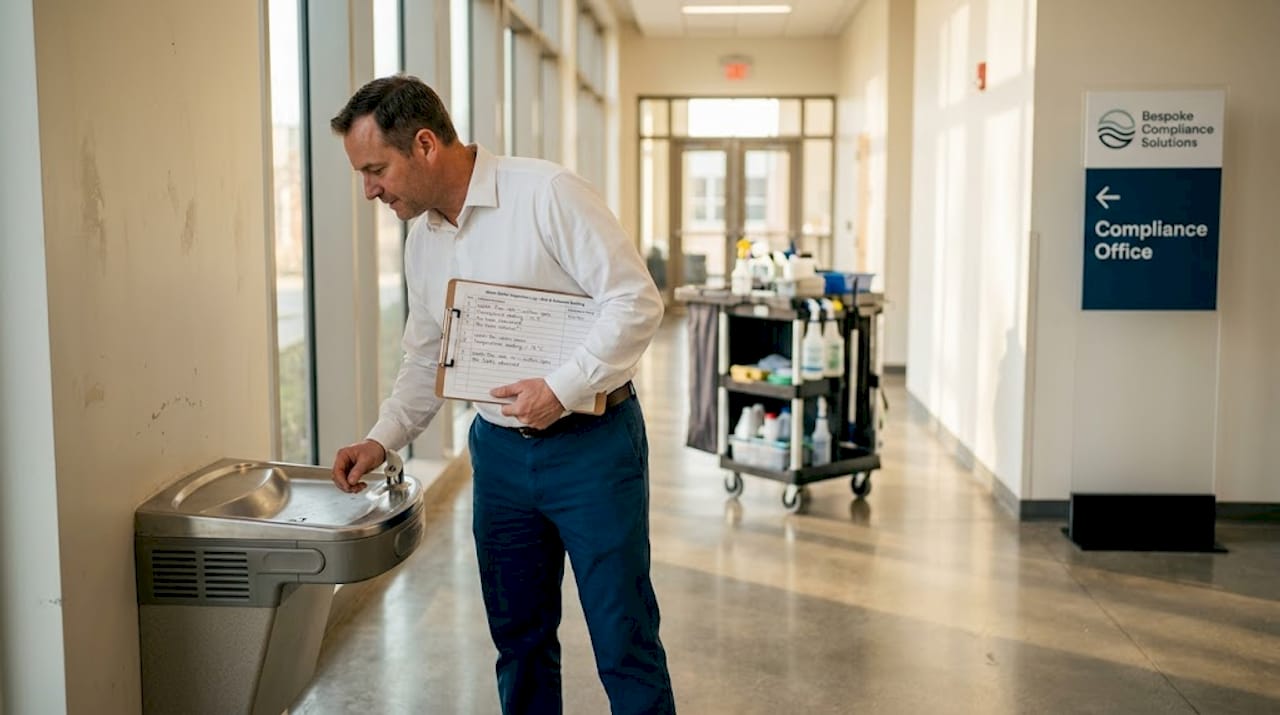
Drinking fountains are one of the most underestimated sources of Legionella risk in commercial buildings. Most facilities managers instinctively focus their water hygiene efforts on cooling towers, hot water systems, and showers, yet the humble drinking fountain sits quietly in corridors, gyms, and schools, potentially harbouring the very conditions that allow Legionella bacteria to multiply and spread. Legionella risk is real precisely because fountains aerosolise water during normal use, creating a direct inhalation pathway. Missing a drinking fountain from your risk assessment is not a minor oversight. It is a compliance failure with legal, financial, and potentially fatal consequences.
Table of Contents
The legal duties: Risk assessment requirements for fountains explained
Step-by-step: Risk assessment and control for drinking fountains
Edge cases: Overlooked risks, vulnerable groups, and uncommon scenarios
Why most risk assessments miss drinking fountains—and what really works
How Bespoke Compliance Solutions can support your water safety duties
Key Takeaways
Point | Details |
Fountains pose serious risks | Aerosolised water and stagnation make drinking fountains significant Legionella hazards, not ‘low risk’ outlets. |
UK law requires assessment | Legislation makes risk assessment and control schemes mandatory for all commercial drinking water systems. |
Ongoing monitoring vital | Flush, clean, and monitor all fountains regularly—cold water above 20°C is also a high risk. |
Missing outlets is costly | Omitting even minor fountains from risk assessments can lead to prosecution, fines, or worse. |
Expert audits prevent gaps | Detailed, professional auditing practices catch overlooked outlets and keep your compliance on track. |
Why drinking fountains are a hidden Legionella risk
Having established why this is an urgent topic, let’s look closer at the actual risks posed by drinking fountains and why they are often missed.
When a drinking fountain operates, it produces a fine mist of water droplets as the arc of water breaks against the basin. That mist is exactly the kind of aerosol that enables Legionella inhalation, making drinking fountains a direct inhalation risk rather than a theoretical one. Many people assume Legionella is only a concern where hot water is heated to scalding temperatures, but the biology is more nuanced. Legionella bacteria thrive in water between 20°C and 45°C, and cold water systems that are poorly insulated, poorly flushed, or installed in warm plant rooms can easily drift into that danger zone.
Stagnation is the other critical factor. A drinking fountain in a seldom-visited corridor, a sports changing room used only on match days, or a staff kitchen closed during a building refurbishment can sit unused for days or even weeks. During that time, the water inside the pipework warms up, nutrients accumulate, and biofilm begins to form on internal surfaces. Biofilm is a thin, protective layer of organic material that shields Legionella from disinfectants and flushing. Once established, it is extremely difficult to eradicate without specialist intervention.
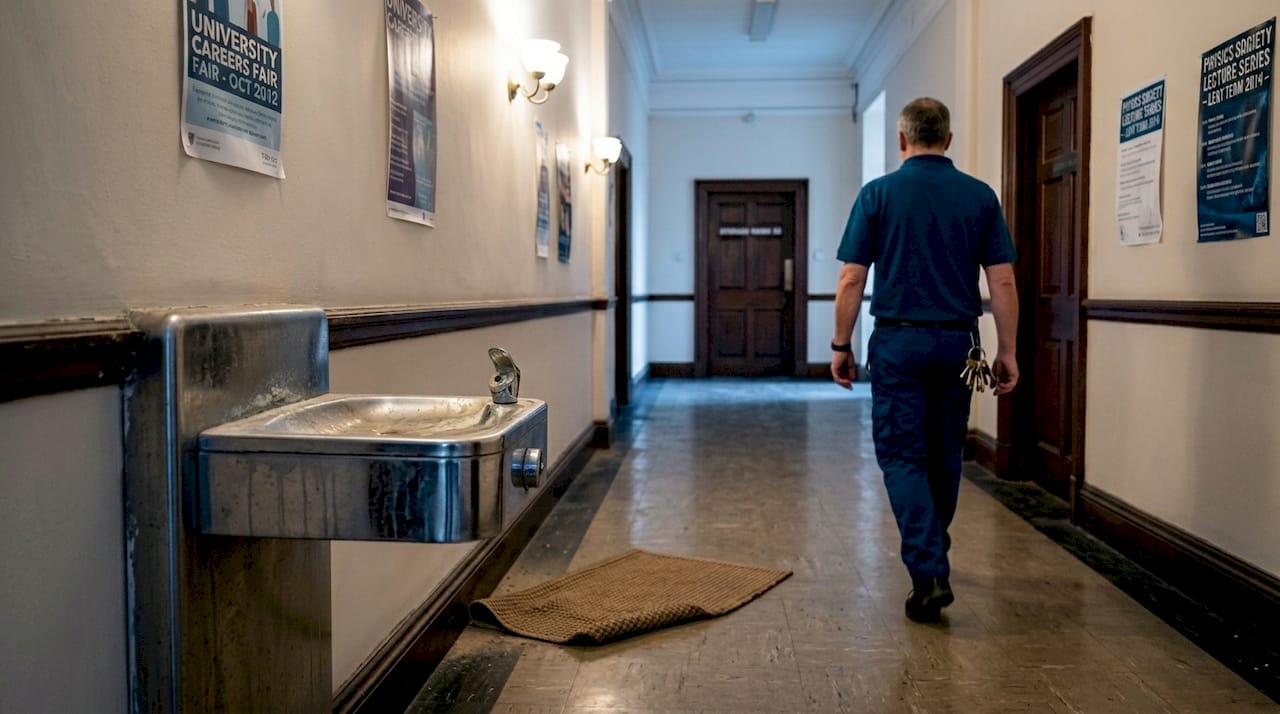
The HSE is explicit on this point. Its safety bulletin on Legionella control confirms that drinking fountains are frequently overlooked as “low risk” when, in reality, the combination of aerosol generation and potential stagnation makes them critical assets in any water system inventory. The HSE expects all outlets, without exception, to be included in the risk assessment scope for compliance duties for commercial premises.
Key risk factors for Legionella in drinking fountains include:
Infrequent use leading to prolonged water stagnation in supply pipework
Warm ambient temperatures in plant rooms or poorly insulated risers pushing cold water above 20°C
Inadequate or absent flushing regimes between periods of low occupancy
Biofilm accumulation in pipework that is rarely cleaned or descaled
Poor water flow design, including dead legs, which trap water and reduce effective flushing
Shared pipework with other outlets that may already be poorly controlled
“The failure to include all outlets in a risk assessment is one of the most common non-conformances identified during HSE enforcement visits. Drinking fountains are regularly absent from site water system schematics, even in otherwise well-managed buildings.”
The legal duties: Risk assessment requirements for fountains explained
Understanding the science is one side. Let’s explore your legal duties and what the law expects around drinking fountain assessments.
UK law is unambiguous. Under the Health and Safety at Work Act 1974, COSHH 2002, and ACOP L8, every employer or person in control of premises has a duty to identify and assess the risks from Legionella bacteria in their water systems. That duty explicitly covers any water system where conditions are conducive to Legionella growth and where there is a means of creating and disseminating aerosols. Drinking fountains satisfy both criteria without exception.
ACOP L8, the Approved Code of Practice that sets the operational standard for Legionella management, requires a suitable and sufficient risk assessment to be carried out by a competent person. The assessment must cover all systems, document findings, and lead to a written control scheme. Critically, if an employer fails to comply with ACOP L8 requirements and a prosecution follows, the burden shifts to the employer to demonstrate they had adequate alternative controls in place. That is a very difficult position to defend in court.
The consequences of non-compliance are severe. The HSE can issue improvement notices, prohibition notices, and ultimately pursue criminal prosecution. Unlimited fines, imprisonment for responsible individuals, and business closure are all real outcomes. Since the Legionella prosecution of a hotel operator in 2013 resulted in a seven-figure fine, courts have shown no reluctance to apply substantial penalties where duty holders have failed to act.
Legal instrument | Key requirement | Consequence of breach |
Health and Safety at Work Act 1974 | Duty to ensure health and safety of employees and others | Criminal prosecution, unlimited fines |
COSHH Regulations 2002 | Assess and control risk from hazardous biological agents including Legionella | Enforcement notices, prosecution |
ACOP L8 | Carry out risk assessment, implement control scheme, record and review | Reversal of burden of proof in prosecution |
HSG274 Technical Guidance | Specific guidance on control of Legionella in water systems | Used as evidence of inadequate practice |
Pro Tip: Document every single water outlet in your building, including seldom-used drinking fountains, emergency eyewash stations, and decorative features. A complete outlet inventory is the single most effective way to demonstrate legal compliance during an HSE inspection or following an outbreak investigation.
Scheduling a review process for risk assessments at defined intervals is not optional. The law requires review whenever there is reason to believe the assessment is no longer valid, and periodic review at least every two years is widely accepted as best practice. Practical examples of compliant assessments show how thorough site surveys capture drinking fountains and minor outlets that paper-based checklists frequently miss.
Step-by-step: Risk assessment and control for drinking fountains
You have seen the legal landscape. Here is exactly how to put compliance into practice, step by step.
The risk assessment methodology per ACOP L8 and HSG274 follows a clear structure. Each stage builds on the previous, and skipping any one of them creates a gap that can undermine the entire control programme.
Appoint a competent responsible person. This individual must have sufficient knowledge of Legionella risks and water systems to lead the assessment and oversee the control scheme. For drinking fountains, this means understanding both the plumbing configuration and the usage patterns of the building.
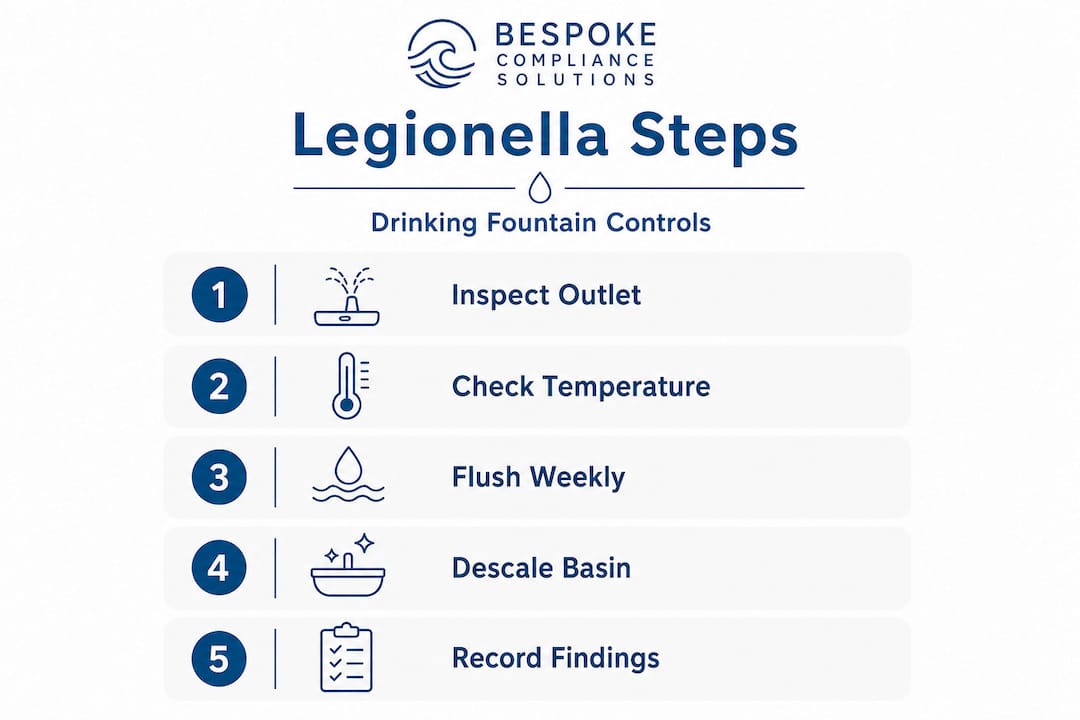
Identify all water systems and outlets. Walk the building systematically, cross-referencing as-built drawings with physical inspection. Mark every drinking fountain, noting its location, supply route, flow rate, and typical usage frequency.
Assess conditions for Legionella growth. For each fountain, record water temperature at the outlet, check for stagnation risk, inspect for biofilm or scale build-up, and confirm the supply pipework configuration is free of dead legs.
Evaluate and grade the risk. Use the data collected to assign a risk rating. A fountain that is used daily, supplied by well-maintained pipework, and consistently delivers cold water below 20°C is lower risk than one used infrequently in a warm environment.
Implement a written control scheme. Document the specific controls for each fountain, including flushing frequency, temperature monitoring schedules, descaling intervals, and any remedial works required.
Monitor, record, and review. Keep a detailed logbook for each outlet. Record every monitoring check, every flush, and every remedial action taken. Review the full risk assessment at defined intervals or following any significant change.
The table below summarises the principal controls and monitoring frequencies for drinking fountains:
Control measure | Cold water fountains | Hot water fountains | Monitoring frequency |
Temperature at outlet | Must be below 20°C | Must be above 50°C | Monthly minimum |
Flushing of infrequently used outlets | Weekly minimum | Weekly minimum | Log every flush |
Descaling and cleaning | Six-monthly | Six-monthly | Record date and findings |
Biofilm inspection | Annual physical inspection | Annual physical inspection | Part of risk review |
Water sampling | Following remediation or concern | Following remediation or concern | As risk assessment directs |
Pro Tip: If a practical temperature check reveals that cold water at a drinking fountain outlet consistently exceeds 20°C, do not simply note it and move on. This is a trigger for immediate investigation into the cause, whether that is poor insulation, a nearby heat source, or a dead leg in the supply pipework. Investigate and remediate before the next scheduled check.
A common mistake is relying solely on temperature monitoring without carrying out physical inspections for scale, sediment, and biofilm. Temperature alone does not tell the full story. A fountain that delivers cold water at 17°C may still have significant biofilm in its internal components if it has never been descaled.
Edge cases: Overlooked risks, vulnerable groups, and uncommon scenarios
Having covered typical controls, it is essential to address less obvious risks and special scenarios where extra care is needed.
Some of the most significant Legionella risks in commercial buildings arise not from the main water systems but from outlets that fall outside the routine maintenance cycle. Drinking fountains installed for specific events, such as sports days, open days, or emergency evacuation procedures, can sit dormant for months and receive no monitoring at all. From a legal perspective, they are just as much your responsibility as a fountain used every day.
The guidance on health services Legionella specifically highlights cold water systems as a risk area that is too often dismissed. If cold water is stored or distributed through poorly managed pipework, temperatures above 20°C are not uncommon, particularly in summer months or in buildings with inadequate cold water insulation. Decorative fountains present an even higher aerosol risk than functional drinking fountains because they are designed to produce visual water movement, which inherently generates fine droplets over a larger area.
Facilities near hospitals, care homes, schools, and any setting that regularly serves immunocompromised individuals or elderly people carry a heightened duty of care. Legionnaires’ disease carries a fatality rate of 10 to 15%, and outbreaks among vulnerable populations have historically been more lethal. A 2022 Yorkshire outbreak linked to cold water taps and showers demonstrated that inadequate control of cold water systems, including infrequently used outlets, can cause serious community harm.
Situations where drinking fountains carry especially high risk include:
Fountains in buildings reopened after extended closure or renovation
Outlets in areas with seasonal or event-driven use only
Fountains supplied by long runs of small-bore pipework with low flow velocity
Cold water fountains in buildings without adequate cold water insulation in plant rooms
Decorative water features in reception or atrium areas that produce visible aerosols
Any outlet located in proximity to immunocompromised building users, such as in healthcare or education settings
The risk considerations in education settings are particularly acute. School buildings often contain large numbers of drinking fountains that are heavily used during term time and then left completely idle during long school holidays. Without a structured flushing programme during those periods, the risk of Legionella colonisation increases significantly by the time pupils and staff return.
Why most risk assessments miss drinking fountains—and what really works
With the risks and controls clearly set out, it is time for a frank look at why many firms still get this wrong and what your peers do differently.
The honest answer is cultural, not technical. Most Legionella risk assessments are initiated in response to regulatory pressure rather than genuine proactive management. When the scope is defined under time pressure, drinking fountains tend to fall into the category of “obvious low risk.” They are small. They use cold water. They are not the cooling tower or the calorifier. That mental shortcut is exactly how critical outlets get omitted from what is otherwise a thorough assessment.
There is also a practical problem with documentation. Many commercial buildings have undergone multiple refurbishments over the years, and the as-built drawings rarely reflect reality. Drinking fountains are added, relocated, or decommissioned without the water system schematics being updated. A risk assessment that relies on drawings alone will inevitably miss physical outlets. The only way to close that gap is a systematic outlet-by-outlet walk-through, conducted by someone with both the technical knowledge and the time to look carefully.
What actually works, in our direct experience, is combining three things. First, a physical walk-through of every area of the building, including plant rooms, fire escapes, sports facilities, and rarely visited corridors. Second, a cross-reference of findings against building schematics, with discrepancies flagged and investigated. Third, direct input from frontline staff, cleaners, porters, and receptionists who often know which fountains are never used or which areas flood regularly. No desk-based assessment can replicate that intelligence.
The risk assessment review process should not be treated as a periodic administrative exercise. It should be a live, ongoing process where any change to building use, occupancy, or infrastructure triggers a targeted review of the affected outlets. Periodic walk-throughs, combined with logbook cross-checks that compare recorded actions against actual site conditions, catch the gaps that a tick-box approach never will.
How Bespoke Compliance Solutions can support your water safety duties
If you are seeking confidence in your compliance programme, here is how expert support can make a genuine difference.
Drinking fountain Legionella compliance sits at the intersection of technical knowledge, regulatory expertise, and practical site management. Getting it right requires more than a template assessment. It demands a bespoke approach that reflects your building’s actual configuration, usage patterns, and risk profile.
At Bespoke Compliance Solutions, we work with facilities and health and safety managers across commercial, healthcare, education, and hospitality settings to ensure that every outlet, including drinking fountains, is properly assessed, controlled, and documented. Our Legionella management for offices service covers full site surveys, bespoke risk assessments, and the implementation of logbook systems that make ongoing compliance straightforward. Where monitoring identifies concern, our expert water testing service provides rapid laboratory analysis to support evidence-based decision making. Contact us to discuss a tailored audit of your drinking fountain provision and water safety duties.
Frequently asked questions
What makes drinking fountains a Legionella risk in offices and schools?
Fountains produce aerosols during normal operation, and if water stagnates or reaches unsafe temperatures, Legionella bacteria can be inhaled directly from the water mist, making them a genuine transmission risk.
Do cold water drinking fountains require monitoring for Legionella?
Yes. Where cold water exceeds 20°C or stagnation is present, even cold-fed fountains must be closely monitored and controlled in accordance with HSE guidance.
How often should drinking fountains be flushed or cleaned?
Flush infrequently used outlets weekly and carry out physical cleaning and descaling on a regular schedule, particularly for decorative or event-only fountains that may sit dormant for extended periods.
What are the consequences of not conducting a risk assessment for drinking fountains?
Non-compliance can result in unlimited fines, criminal prosecution of responsible individuals, and in serious cases, business closure under HSE enforcement action.
Recommended
Comments