
Role of compliance manager: water hygiene guide

The role of compliance manager in water hygiene is defined as the designated responsible person who oversees Legionella risk management, implements written control schemes, and maintains regulatory compliance under ACOP L8 and HSG274. This is not an administrative function. It is a legally accountable position that sits at the centre of protecting building occupants from Legionnaires’ disease, a potentially fatal respiratory illness caused by Legionella pneumophila bacteria proliferating in poorly managed water systems. Whether you work in healthcare, commercial property, housing associations, or facilities management, your water hygiene compliance duties carry direct legal weight under the Health and Safety at Work Act 1974.
What are the statutory responsibilities of a compliance manager for water hygiene?
The compliance manager, formally recognised in UK regulation as the Responsible Person, holds quasi-legal obligations defined by ACOP L8 and HSG274. These documents are not optional guidance. ACOP L8 carries special legal status: failure to follow it can be used as evidence of non-compliance in criminal proceedings.
Your core statutory duties include:
Commissioning and maintaining a documented Legionella risk assessment for every water system under your control
Developing and implementing a written scheme of control, detailing how each identified risk will be managed
Appointing competent individuals to carry out monitoring tasks, with clear records of their training and authority
Retaining all compliance records, including temperature logs, flushing schedules, and maintenance reports, for a minimum of five years
Conducting or commissioning monthly temperature checks at defined thresholds across the water system
The table below summarises the key monitoring thresholds defined in HSG274 Part 2:
Parameter | Threshold | Frequency |
Hot water at outlet | ≥50°C within 1 minute | Monthly |
Stored hot water (calorifier) | ≥60°C | Monthly |
Cold water at outlet | ≤20°C | Monthly |
Unused outlet flushing | 2 minutes minimum | Weekly or after 7 days’ non-use |
A critical distinction exists between the duty holder and the compliance manager. The duty holder, typically the employer or building owner, retains ultimate legal liability regardless of who is appointed as Responsible Person. You, as compliance manager, carry delegated operational accountability. That distinction matters enormously when enforcement action is taken.
Pro Tip: Document the formal appointment of your role in writing, signed by the duty holder. This creates a clear chain of accountability and protects both parties during inspections or investigations.
What practical tasks does a compliance manager handle day to day?
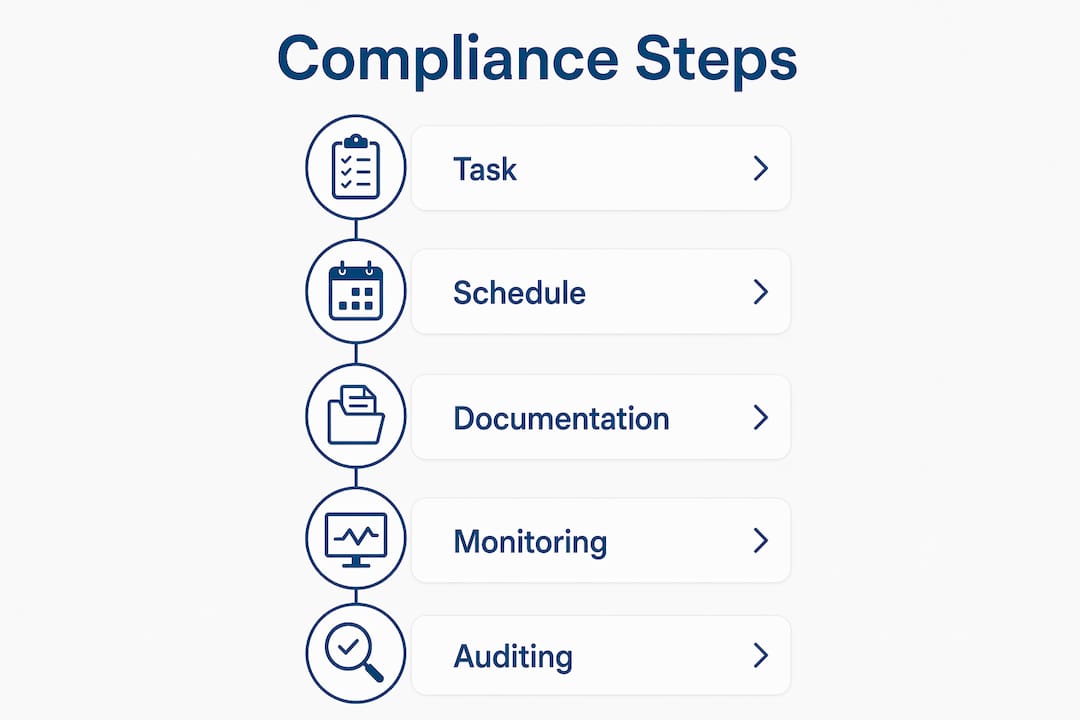
Water hygiene compliance duties are not confined to annual risk assessments. They require a structured programme of daily, weekly, monthly, and annual activities, each of which you are responsible for either performing or verifying.
Weekly flushing of infrequently used outlets. Outlets unused for 7 or more days must be flushed for at least two minutes, or until temperatures stabilise close to supply temperatures. This prevents stagnant water conditions where Legionella thrives.
Monthly temperature monitoring. You must verify that hot water reaches at least 50°C at the outlet within one minute, that stored hot water is maintained at 60°C or above, and that cold water remains at or below 20°C. Deviations require immediate investigation and corrective action.
Showerhead and hose descaling. Showerheads and flexible hoses are high-risk components. They must be descaled and disinfected quarterly as a minimum, since limescale and biofilm create ideal conditions for bacterial growth.
Cold water storage tank inspections. Annual inspections of cold water storage tanks check for contamination, structural integrity, and adequate insulation. You are responsible for commissioning these inspections and reviewing the findings.
Contractor supervision and audit. When you delegate tasks to approved contractors, your responsibility does not end at sign-off. You must conduct independent check-the-work audits to verify that contracted activities have been completed correctly and to the required standard.
Training and competency management. Staff performing water hygiene tasks must be adequately trained and their competency documented. This includes induction training, refresher courses, and site-specific briefings on your water system layout.
The practical reality is that most compliance managers are coordinating these activities across multiple sites or within complex buildings. A structured logbook system, whether digital or physical, is the only reliable way to track completion and demonstrate compliance when inspectors arrive.
Pro Tip: Build a monthly compliance calendar that maps every required task to a named responsible individual. Review it at the start of each month and flag any gaps before they become enforcement risks.

How does the compliance manager ensure audit-ready record-keeping?
Failure to maintain complete logbooks is one of the most common triggers for enforcement action in water hygiene compliance. Passing water tests alone does not constitute compliance. Regulators expect a complete documentary trail across all monitored activities.
Your record-keeping obligations cover the following areas:
Risk assessments. The current risk assessment must be accessible on site and reviewed at least every two years, or immediately following any significant change to the water system or building use.
Written scheme of control. This document must be kept up to date and reflect the actual system in operation, not a theoretical one.
Temperature monitoring logs. Every monthly temperature check must be recorded with the date, location, result, and the name of the person who conducted it.
Flushing records. Weekly flushing logs must show which outlets were flushed, when, and by whom. Gaps in flushing records are treated as evidence of non-compliance.
Maintenance and remedial action reports. Any corrective action taken following an out-of-range result must be documented, including what was done, when, and by whom.
Compliance documentation must be retained for a minimum of five years. Failure to do so can result in unlimited fines and imprisonment under the Health and Safety at Work Act 1974. That is not a theoretical risk. Enforcement notices and prosecutions have been issued to organisations that had functioning water systems but inadequate records.
Digital logbook systems offer a significant advantage over paper records. They provide time-stamped entries, automated reminders for overdue tasks, and instant retrieval during audits. A well-structured Legionella logbook removes the risk of lost or illegible records and makes audit preparation straightforward rather than stressful.
What are the legal liabilities and delegation limits for compliance managers?
Legal accountability in water hygiene follows a clear hierarchy, and understanding where your liability begins and ends is not optional. It is a professional necessity.
Role | Accountability | Can be delegated? |
Duty holder | Ultimate legal liability for all water hygiene obligations | No |
Responsible Person / compliance manager | Operational compliance and day-to-day management | Partially |
Appointed competent person | Specific monitoring and maintenance tasks | Yes, with oversight |
Contractor | Contracted technical work | Yes, with audit |
The duty holder cannot legally transfer responsibility by appointing a compliance manager. They remain unequivocally liable. What they transfer is the operational authority to act. You, as compliance manager, must have genuine authority to make decisions, including halting operations if a water hygiene risk arises. A compliance manager without that authority is a compliance manager without the means to comply.
Delegating tasks to contractors does not remove your legal exposure. You must conduct independent audits of contractors’ work to avoid negligence under the relevant regulations. If a contractor fails to complete a task correctly and you have not verified their work, the liability sits with you and the duty holder, not the contractor.
Appointing a deputy responsible person is a practical safeguard that many organisations overlook. If you are absent through illness, leave, or a change of role, compliance activities must continue without interruption. A named, trained deputy prevents the gaps in monitoring that create the conditions for Legionella growth.
Pro Tip: Review your appointment letter annually. Confirm it accurately reflects your current authority, the systems you are responsible for, and the resources available to you. Outdated appointment documentation is a liability in itself.
What best practices help compliance managers excel in water hygiene?
The 2026 regulatory emphasis has shifted decisively toward demonstrable competence over procedural box-ticking. Compliance managers are now expected to understand their specific building water systems in depth and to explain risk profiles clearly during inspections. That requires a more proactive and strategic approach than many organisations currently apply.
The following practices separate effective compliance managers from those who are merely reactive:
Use specialist external contractors for complex systems. Cooling towers, spa pools, and large calorifier systems require technical expertise beyond most in-house teams. Engaging specialist contractors for these components, while retaining audit oversight, is both practical and legally sound.
Implement automated temperature monitoring. Automated monitoring systems provide continuous data rather than monthly snapshots. They detect temperature excursions in real time, enabling corrective action before a problem escalates. This is particularly valuable in large or complex buildings.
Schedule regular reviews of risk assessments and written schemes. Reviews must occur at least every two years, or after any significant change. Many compliance managers treat this as a passive renewal. The more effective approach is to treat each review as an active interrogation of whether the current controls are still fit for purpose.
Develop clear incident escalation processes. When a temperature excursion or positive Legionella test result occurs, every person involved must know exactly what to do and in what order. A documented escalation protocol prevents delays that increase both health risk and legal exposure.
Invest in staff competency as a continuous process. Competence is defined by practical site-specific knowledge, not classroom certification alone. Regular site walkthroughs, system familiarisation, and scenario-based training build the kind of understanding that holds up under regulatory scrutiny.
Key takeaways
The compliance manager’s role in water hygiene is a legally accountable position requiring documented control, regular monitoring, and demonstrable competence across every water system under their authority.
Point | Details |
Statutory duties are non-negotiable | ACOP L8 and HSG274 define specific monitoring thresholds and documentation requirements that carry legal force. |
Records must be retained for five years | Incomplete logbooks are a leading cause of enforcement action, regardless of whether water tests pass. |
Delegation does not remove liability | Tasks can be delegated to contractors, but audit oversight and ultimate accountability remain with the compliance manager and duty holder. |
Competence means site-specific knowledge | Regulatory inspections in 2026 require compliance managers to explain their water system’s risk profile, not just produce paperwork. |
A deputy responsible person is a necessity | Appointing a trained deputy prevents compliance gaps during absences and protects the organisation from unmanaged risk. |
The compliance manager’s role is changing. Here is what that means in practice.
Having worked closely with compliance managers across healthcare, commercial property, and housing associations, I have noticed a consistent pattern. The organisations that struggle most are not the ones with bad intentions. They are the ones treating water hygiene compliance as a documentation exercise rather than a live risk management function.
The regulatory direction in 2026 is unambiguous. Inspectors are no longer satisfied with a folder of completed forms. They want to speak with the compliance manager and hear them explain the water system, the known risks, and the controls in place. That requires a depth of site-specific knowledge that you cannot acquire by reviewing reports from a desk.
My honest view is that the biggest risk most compliance managers face is over-reliance on contractors without genuine oversight. Contractors are valuable, but they are not a substitute for your own understanding of the system. If a contractor misses a task or records a result incorrectly, you are the one who needs to catch it. That only happens if you know what correct looks like.
The compliance managers I have seen perform best are those who treat their written scheme of control as a living document, who walk their water systems regularly, and who invest in training not as a compliance tick but as a genuine tool for risk reduction. The paperwork follows naturally from that level of engagement. It does not precede it.
— Sammi
How Bespokecompliancesolutions supports compliance managers
Bespokecompliancesolutions works directly with compliance managers and health and safety professionals across the UK to make water hygiene compliance manageable, auditable, and site-specific. Whether you need a full water system disinfection to address an identified risk, or ongoing support with Legionella compliance for commercial premises, the team builds solutions around your organisation’s actual water systems, not generic templates.
Services include bespoke Legionella risk assessments, water testing and analysis, logbook implementation, automated temperature monitoring, and ongoing consultancy. If you are reviewing your current compliance programme or preparing for an inspection, contact Bespokecompliancesolutions for a tailored assessment of your site’s needs.
FAQ
What is the role of a compliance manager in water hygiene?
The compliance manager, formally known as the Responsible Person under ACOP L8, is accountable for implementing and overseeing all Legionella control measures across a building’s water systems. This includes commissioning risk assessments, managing monitoring programmes, and maintaining five years of compliance records.
What are the main water hygiene regulations compliance managers must follow?
ACOP L8 and HSG274 are the primary regulatory references for water hygiene compliance in the UK. ACOP L8 carries quasi-legal status, meaning failure to follow it can be used as evidence of non-compliance in legal proceedings.
How often must water temperature checks be carried out?
Monthly temperature monitoring is required under HSG274 Part 2, with hot water outlets needing to reach at least 50°C within one minute, stored hot water maintained at 60°C or above, and cold water kept at or below 20°C.
Can a compliance manager delegate water hygiene tasks to contractors?
Tasks can be delegated to competent contractors, but legal accountability remains with the compliance manager and duty holder. Independent audits of contracted work are required to avoid negligence under UK health and safety regulations.
How long must water hygiene compliance records be kept?
All compliance documentation, including risk assessments, temperature logs, and flushing records, must be retained for a minimum of five years. Failure to maintain complete records can result in unlimited fines and imprisonment under the Health and Safety at Work Act 1974.
Recommended
Comments