
Types of water hygiene testing in healthcare: a compliance guide

Healthcare water systems require three core types of testing: microbiological, chemical, and physical. Together, these form the surveillance backbone of any Water Safety Plan (WSP) under HTM 04-01. Beyond the standard distribution system, certain clinical equipment demands its own specialist testing regime with stricter limits and different sampling protocols.
The five tests to commission first:
Legionella spp. culture or targeted PCR — the primary microbiological risk in healthcare water systems
Pseudomonas aeruginosa — zero tolerance in augmented care and immunocompromised patient areas according to guidance
Total viable count (TVC) — trend monitoring to detect biofilm development early
Disinfectant residual (free chlorine or chloramine) — operational evidence that biocide is reaching all parts of the system
Temperature monitoring — the single most cost-effective control measure for Legionella
Specialist clinical equipment adds further obligations: renal dialysis water, endoscopy final rinse water, dental unit waterlines, and heater–cooler units each carry their own parameters, limits, and sampling frequencies that sit outside the general distribution-system testing schedule.
Pro Tip: Before commissioning any testing, confirm that your Water Safety Group (WSG) has formally agreed the sampling plan. A test result is only defensible if it was collected as part of a documented, WSG-approved programme.
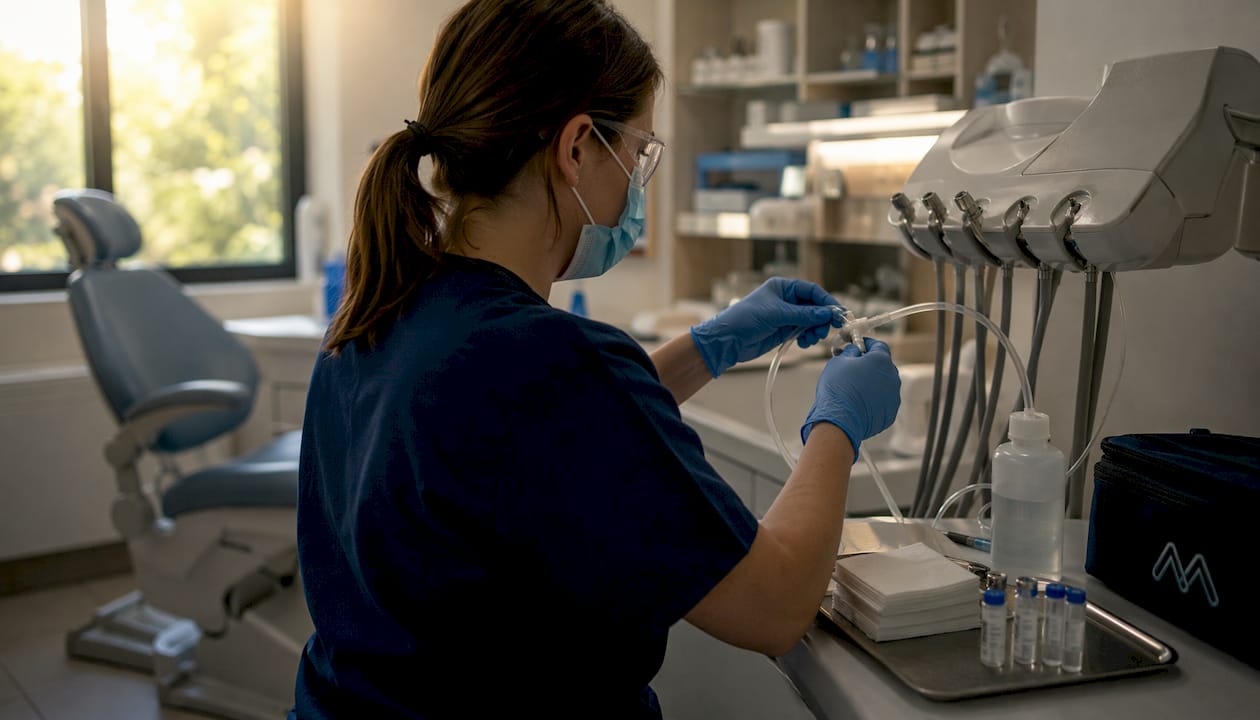
Table of Contents
Microbiological testing: which organisms, which samples, and what the results mean
Physical testing and continuous monitoring: temperature, turbidity, and TMV checks
Specialist clinical-equipment water testing: dialysis, endoscopy, HCUs, and dental units
How to get sampling right: chain of custody, accreditation, and what to insist on
How often should you test, and what do results actually tell you?
How to appoint a competent water-testing provider for healthcare
How Bespokecompliancesolutions approaches healthcare water hygiene testing
A practitioner’s view on where healthcare water testing goes wrong
Bespokecompliancesolutions: your next step for healthcare water testing
Useful sources and standards for your WSP and procurement documents
What do the three testing domains actually cover?
The phrase “water hygiene testing” covers a lot of ground. In a healthcare context, it is worth being precise about what each domain involves, because conflating them leads to gaps in the WSP.
Microbiological testing looks for organisms: bacteria, endotoxins, and in specialist settings, environmental mycobacteria. Examples include Legionella culture from a sentinel outlet or Pseudomonas aeruginosa from an augmented care tap. Chemical testing measures dissolved substances: disinfectant residuals, pH, metals such as lead and copper, and endotoxins for clinical rinse water. Physical testing covers measurable properties of the water and system: temperature, turbidity, flow rates, and the condition of thermostatic mixing valves (TMVs).
Testing does not replace a WSP. Under HTM 04-01, testing validates that the control measures described in the WSP are working. The WSG interprets results, decides on remedial action, and updates the plan accordingly. A positive Legionella result without a WSP to reference is a compliance failure even before the remediation question arises.
The key UK standards and guidance that frame testing expectations are:
HTM 04-01 (Parts A and B) — the primary NHS England guidance on safe water in healthcare premises
HSE guidance on testing and monitoring for Legionella
UKAS (United Kingdom Accreditation Service) — accreditation body for laboratories and testing methods
BS 7592 — British Standard for sampling and culturing of water from healthcare and other premises for Legionella
ISO/EN 19458 — the international standard for microbiological sampling of water supply systems
When appointing a laboratory or contractor, these are the standards to cite in the tender and the contract. If a supplier cannot reference them, that is a warning sign worth acting on before sampling begins.
Microbiological testing: which organisms, which samples, and what the results mean
Microbiological testing is where most healthcare water programmes begin, and where the most consequential results appear. Getting the sampling technique right matters as much as choosing the right parameters.
Priority organisms and parameters
The organisms to test for in a healthcare setting, in rough order of clinical priority:
Legionella spp. — culture (the standard method under BS 7592) and targeted PCR where agreed with the WSG and laboratory; PCR is faster but detects DNA rather than viable organisms, so results require careful interpretation
Pseudomonas aeruginosa — zero tolerance (0 cfu/100 ml) in augmented care, neonatal units, and any area serving immunocompromised patients
Total viable counts (TVCs) — at 22°C and 37°C; used for trend monitoring rather than pass/fail in isolation
Coliforms and E. coli — indicators of faecal contamination or cross-connection; zero tolerance in healthcare
Enterococci — zero tolerance in many healthcare contexts
Environmental mycobacteria — where clinically indicated, particularly in units with vulnerable patients
Sampling technique: pre-flush versus post-flush
The distinction between pre-flush and post-flush samples is one of the most practically useful tools in healthcare water microbiology. A pre-flush sample is taken immediately on opening the tap, capturing whatever has been sitting in the outlet, aerator, or nearby fittings. A post-flush sample is taken after running the water for a defined period, drawing water from further back in the distribution system.
When pre-flush counts are substantially higher than post-flush, the problem is localised to the outlet or fitting. When both are similarly elevated, the contamination is systemic and requires a broader response. This distinction directly shapes remedial action: replacing an aerator versus disinfecting a whole riser are very different interventions.
Microbiological limits and sample specifications
Parameter | Sample bottle | Volume | Typical limit (healthcare) | Routine frequency trigger |
Legionella spp. | Sterile 1-litre | 1 litre | Not detected in high-risk units | Risk-based; minimum testing every six months in high-risk settings |
Pseudomonas aeruginosa | 1 litre with neutraliser | 1 litre | 0 cfu/100 ml (augmented care) | Risk-based; minimum testing every six months in high-risk settings |
Total viable count | 1 litre with neutraliser | 1 litre | Varies; <10 cfu/ml for endoscopy final rinse | Quarterly or per WSG decision |
Coliforms / E. coli | 1 litre with neutraliser | 1 litre | 0 cfu/100 ml | Routine surveillance |
Enterococci | 1 litre with neutraliser | 1 litre | 0 cfu/100 ml | Routine surveillance |
Limits shown are indicative of UK healthcare guidance. The WSG should confirm applicable limits for each area based on patient risk category.
Pro Tip: Before samples leave site, confirm with the laboratory that bottles contain the correct neutralising agent for your disinfection system. Sodium thiosulphate is standard for chlorinated systems, but failing to neutralise residual biocide gives misleadingly low counts — hiding contamination rather than detecting it. Confirm storage temperature requirements too: Legionella samples and general microbiological samples have different handling instructions.
Chemical testing: what to measure and why it matters
Chemical monitoring is often treated as a secondary concern behind microbiology, but it is the operational heartbeat of a water safety programme. Disinfectant residuals tell you whether your control measures are actually reaching every part of the system.
Parameters to monitor
Free chlorine or chloramine residuals — the primary evidence that biocide is present at point of use; measured on-site with colourimetric or electronic meters, confirmed periodically by laboratory analysis
Chlorine dioxide — where used as a supplementary disinfectant; requires specific on-site measurement equipment
pH — affects disinfectant efficacy; chlorine is significantly less effective above pH 8, so a rising pH reading is an early warning of reduced biocide performance
Conductivity — useful for detecting cross-connections or changes in water source
Lead and copper — relevant where older pipework is present or where plumbing modifications have been made; tested by laboratory analysis of standing or flushed samples
Endotoxins — critical for clinical rinse water (see specialist equipment section below)
Disinfectant residuals in practice
On-site colourimetric testing (DPD tablets or electronic photometers) is the standard approach for routine residual checks. These should be recorded in the logbook at defined frequencies agreed by the WSG. Laboratory confirmation of residuals is useful periodically, particularly after system modifications or when on-site readings seem inconsistent.
A sudden drop in residual at a sentinel point, without a corresponding change in supply, warrants investigation before the next scheduled test. Similarly, a rising pH trend should prompt a check of dosing equipment and a review of recent water quality reports from the supplier.
Endotoxin limits for clinical water: endoscopy final rinse water carries a limit of <0.25 EU/ml, while renal dialysis fluid uses a stricter limit of <0.125 EU/ml. These are not general distribution-system limits — they apply specifically to water in direct patient contact via clinical equipment.
Physical testing and continuous monitoring: temperature, turbidity, and TMV checks
Physical parameters are the most frequently measured in any healthcare water programme, and for good reason. Temperature is the primary control measure for Legionella, and a single excursion outside target range can indicate a systemic problem.
Temperature targets
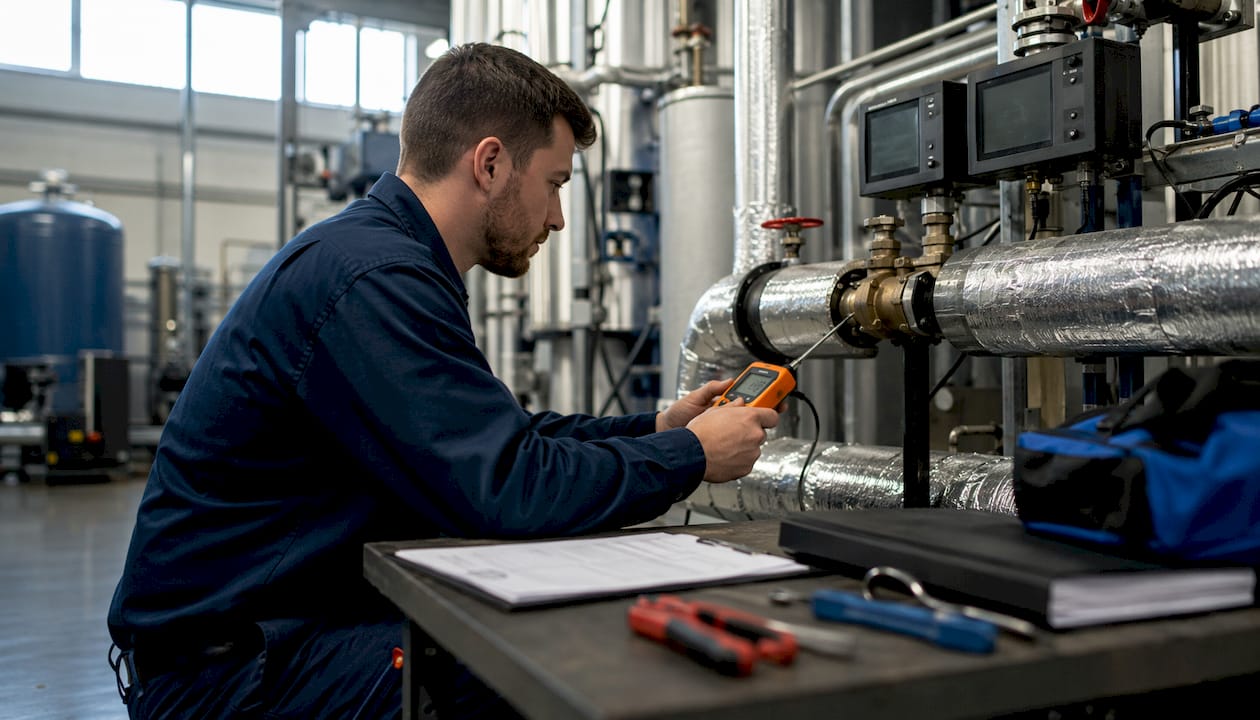
Hot water should reach 55°C within one minute at outlets and cold water should be 20°C or below after running for a couple of minutes. These are the operational targets used in commissioning and routine checks. Legionella multiplies most readily between 20°C and 45°C, so any outlet consistently sitting in that range needs attention.
Temperature checks at sentinel outlets should be recorded at the frequency specified in the WSP. For complex estates, manual temperature logging quickly becomes impractical and inconsistent.
Turbidity and visual checks
Turbidity is a measure of particulate load in the water. In general distribution systems, it is most relevant after maintenance work, system disturbance, or where point-of-use filters are in use. For clinical rinse water (endoscopy, dialysis), turbidity or visible particulate matter is an immediate trigger for investigation and should be recorded alongside microbiological results.
Flow, stagnation, and TMV servicing
Flow and usage monitoring — outlets that are infrequently used are a known Legionella risk; the WSP should identify low-use outlets and specify a flushing regime
TMV servicing — thermostatic mixing valves require periodic inspection, cleaning, and temperature verification; the frequency is typically annual but should be risk-assessed; upstream temperature recording before and after the TMV is necessary to confirm the valve is functioning correctly
Dead legs — identified during risk assessment and either removed or managed through flushing; physical checks should confirm that any dead legs noted in the risk assessment have been addressed
Pro Tip: For estates supplying multiple high-risk clinical areas, automated temperature monitoring removes the manual logging burden and provides continuous data rather than point-in-time snapshots. Trend data from automated systems often reveals temperature excursions that would be missed entirely between manual checks.
Specialist clinical-equipment water testing: dialysis, endoscopy, HCUs, and dental units
General distribution-system testing does not cover clinical equipment water. Each equipment class has its own parameters, limits, and sampling requirements, and the consequences of getting this wrong are direct patient harm rather than a compliance gap.
Parameters, limits, and sampling by equipment class
Equipment | Required tests | Typical limits | Typical sampling frequency |
Renal dialysis water | TVC, endotoxin, chemical (conductivity, pH, hardness) | TVC: varies by stage; endotoxin <0.125 EU/ml for dialysis fluid | Monthly or per manufacturer/clinical guidance |
Endoscopy final rinse | TVC, P. aeruginosa, endotoxin | TVC <10 cfu/ml; P. aeruginosa 0 cfu/100 ml; endotoxin <0.25 EU/ml | Weekly to monthly depending on risk |
Heater–cooler units (HCUs) | Legionella, TVC, P. aeruginosa | Manufacturer-specified; Legionella not detected | Per manufacturer guidance; typically quarterly |
Dental unit waterlines | TVC, P. aeruginosa | TVC qualitative dental guidance; P. aeruginosa 0 cfu/100 ml | Quarterly or per dental guidance |
Limits shown are indicative; always confirm against current manufacturer guidance and the relevant clinical standard.
Key points for each equipment class
Renal dialysis — water quality requirements are defined by the dialysis machine manufacturer and clinical standards; the water treatment train (reverse osmosis, deionisation) must be validated and monitored separately from the building distribution system
Endoscopy final rinse — the endotoxin limits applicable for endoscopy final rinse water and TVC cut-off of <10 cfu/ml apply to the water at the point of patient contact, not at the supply inlet; sampling must reflect this
Heater–cooler units — linked to Mycobacterium chimaera outbreaks in cardiac surgery; manufacturer guidance on cleaning, disinfection, and microbiological monitoring is mandatory and should be documented in the WSP
Dental unit waterlines — often overlooked in hospital dental departments; the waterline biofilm risk is distinct from the main building system and requires its own management protocol
Where UKAS accreditation for a specific clinical equipment testing method does not yet exist, the WSP should document the reasoned approach taken, including the laboratory used, the method applied, and the clinical guidance referenced. This demonstrates due diligence to inspectors even where formal accreditation is unavailable.
How to get sampling right: chain of custody, accreditation, and what to insist on
A technically correct sample collected without proper documentation is almost worthless for regulatory purposes. Chain of custody and laboratory accreditation are not administrative extras; they are what make results defensible.
Stepwise sampling process
Agree the sampling plan at WSG level before any samples are collected; document the agreed plan in the WSP
Use trained samplers who understand pre-flush versus post-flush technique and the correct bottle for each parameter
Label every bottle at the point of collection: site, outlet reference, sample type (pre/post-flush), date, time, and sampler name
Use sterile bottles with the correct neutralising agent for the disinfection system in use; confirm with the laboratory before sampling
Store and transport samples at the temperature specified by the laboratory; Legionella samples and general microbiological samples have different requirements
Submit samples to the laboratory on the day of collection, or within 24 hours for most microbiological tests; confirm the laboratory’s maximum holding time before sampling
Laboratory accreditation: what to require
All laboratories performing environmental water testing should be UKAS-accredited for the specific methods they are performing, not just for water testing in general. A laboratory accredited for drinking water analysis is not automatically accredited for Legionella culture under BS 7592 or for endotoxin testing by limulus amebocyte lysate (LAL) assay. Verify the scope of accreditation on the UKAS website before appointing.
Additionally, require evidence of participation in external proficiency testing schemes. Proficiency scheme performance is the practical test of whether a laboratory’s results are reliable; accreditation alone does not guarantee this.
Documentation checklist
Request the following from any laboratory or sampling contractor before work begins:
UKAS schedule of accreditation (confirm the specific methods and matrices are listed)
Evidence of participation in an external proficiency scheme within the last 12 months
Method statement for each test to be performed
Chain-of-custody form template
Report format example (confirm it includes method references, accreditation number, and action thresholds)
Turnaround times for routine and urgent results
Escalation protocol for out-of-spec results (who is notified, within what timeframe)
How often should you test, and what do results actually tell you?
Frequency is a WSG decision, but it must be grounded in risk. The minimum guidance for high-risk settings is Legionella and P. aeruginosa testing at minimum every six months in high-risk settings. Many healthcare settings test more frequently, particularly in augmented care areas or where the system has a history of positive results.
Triggers for immediate sampling
Do not wait for the scheduled test date when any of the following occur:
A patient infection is epidemiologically linked to a water source
Remedial works, system modifications, or recommissioning have taken place
Persistent low disinfectant residuals at sentinel points
Temperature excursions outside target range at hot or cold outlets
A new clinical area is being commissioned or brought back into use after a period of low occupancy
Commissioning and post-remedial testing can reveal deficiencies that engineering checks alone miss. A system that passes visual inspection may still harbour biofilm at levels that only microbiological testing will detect.
Interpreting results: a practical flowchart
Single outlet positive (pre-flush only) — likely localised to the outlet or fitting; clean or replace the aerator, retest pre- and post-flush; if post-flush is clear, the problem is contained
Single outlet positive (pre- and post-flush both elevated) — systemic contamination is possible; expand sampling to adjacent outlets on the same riser; review temperature records and disinfectant residuals for that zone
Multiple outlets positive — system-level investigation required; convene the WSG, review the WSP, consider remedial disinfection and a full sentinel outlet survey
Rising TVC trend without specific pathogen detection — biofilm development is likely; review flushing records, check for low-use outlets, and consider remedial cleaning before the trend produces a positive pathogen result
Pro Tip: A single pass/fail result tells you what the water was doing on one day. A trend chart covering 12–24 months of TVC results, plotted alongside temperature records and disinfectant residuals, tells you how the system is behaving. WSGs that maintain trend analysis records consistently catch problems earlier and have stronger evidence for regulatory inspections.
The water hygiene corrective action process sets out the stepwise response and documentation requirements after out-of-spec results — worth reviewing before a positive result arrives rather than after.
How to appoint a competent water-testing provider for healthcare
General Legionella knowledge is not sufficient for complex hospital water systems. HTM 04-01 is explicit: healthcare-specific competence is required, and the WSG is responsible for satisfying itself that appointed contractors have it.
Competence evidence to require
UKAS accreditation for each method to be performed (verify the scope, not just the certificate)
Recent healthcare sector references — ask specifically for NHS or independent healthcare clients, not general commercial water testing
Staff competency records: training, qualifications, and evidence of ongoing competence assessment
Participation in an external proficiency scheme within the last 12 months
Familiarity with HTM 04-01, HSE guidance, BS 7592, and ISO/EN 19458
Questions to ask suppliers
Can you provide a sampling plan specifically for our clinical equipment (dialysis, endoscopy, HCUs) as well as the distribution system?
What is your turnaround time for routine results, and what is your emergency response time for a positive Legionella result?
How do you handle chain of custody from sample collection to laboratory report?
Which external proficiency scheme do you participate in, and can you share recent performance data?
Have you worked on sites with augmented care units or immunocompromised patient areas? What additional precautions did you apply?
Procurement note
The contract should specify: sample handling procedures, chain-of-custody requirements, report format (including method references and accreditation number), turnaround times for routine and urgent results, and escalation timelines for out-of-spec results. Vague contracts produce vague results. A healthcare water risk assessment carried out before procurement will identify the specific methods and parameters the contract needs to cover.
Pro Tip: Ask to see a sample laboratory report before signing the contract. A good report includes the method reference, the accreditation number, the action threshold, and a clear indication of whether the result is within or outside specification. If the report format does not include these, the laboratory is not set up for healthcare compliance work.
How Bespokecompliancesolutions approaches healthcare water hygiene testing
A medium-sized independent hospital approached Bespokecompliancesolutions after a regulatory inspection flagged gaps in its water safety documentation: no formal sampling plan for the endoscopy unit’s final rinse water, and temperature records that were incomplete across three clinical wings. The programme Bespokecompliancesolutions implemented covered distribution-system Legionella and P. aeruginosa sampling, endoscopy final rinse testing against the <0.25 EU/ml endotoxin limit, TMV servicing across all clinical areas, and automated temperature monitoring for the high-risk wings. Within two monitoring cycles, the WSG had complete trend data for the first time and was able to demonstrate compliance at the next inspection.
The services Bespokecompliancesolutions provides that are directly relevant to healthcare water testing programmes:
Legionella risk assessments — identifying sampling points, patient risk areas, and control measure gaps
Water sampling and laboratory analysis — UKAS-accredited laboratory partnerships for all standard and specialist methods
TMV servicing — inspection, cleaning, and temperature verification with documented records
Automated temperature monitoring — continuous logging for complex estates and high-risk clinical areas
Remedial disinfection — thermal and chemical disinfection following positive results or system disturbance
Bespoke logbook systems — structured record-keeping aligned to WSP requirements and inspection expectations
Legionella awareness training — on-site and online, for WSG members and estates staff
Effective healthcare water hygiene testing is not a one-off exercise. It is a continuous programme of surveillance, trend analysis, and documented decision-making by a competent WSG — and the testing provider you appoint must understand that distinction.
Pro Tip: When reviewing your water hygiene compliance across multiple sites, map each site’s WSP against the testing schedule actually being delivered. The gap between what the WSP says should happen and what is recorded in the logbook is where regulatory risk lives.
Key takeaways
Healthcare water safety requires microbiological, chemical, and physical testing validated against a documented Water Safety Plan, with specialist clinical-equipment testing sitting outside the general distribution-system schedule and carrying stricter limits.
Point | Details |
Three testing domains | Microbiological, chemical, and physical testing together validate the WSP; no single domain is sufficient alone. |
Clinical equipment exceptions | Dialysis, endoscopy, HCUs, and dental units require separate testing with stricter limits, including endotoxin <0.125 EU/ml for dialysis fluid and <0.25 EU/ml for endoscopy final rinse. |
Minimum testing frequency | High-risk settings require Legionella and P. aeruginosa testing at minimum every six months in high-risk settings; triggers such as patient infection or remedial works require immediate sampling. |
UKAS accreditation scope | Verify that the laboratory’s UKAS accreditation covers the specific methods and matrices required, not just water testing in general. |
Bespokecompliancesolutions | Provides end-to-end healthcare water testing programmes including sampling, TMV servicing, automated temperature monitoring, and remedial disinfection across UK sites. |
A practitioner’s view on where healthcare water testing goes wrong
The most common failure mode in healthcare water testing is not a missing test. It is over-reliance on isolated pass/fail results with no trend context. A facility that tests every six months, gets a “pass” each time, and files the report without plotting the data against temperature records and disinfectant residuals is not managing risk. It is producing paperwork.
The second most common problem is contractor competence. A supplier who is UKAS-accredited for drinking water analysis but has never sampled an endoscopy unit’s final rinse water, or who does not know the difference between a pre-flush and post-flush sample, will produce results that look valid but are not. The WSG’s responsibility to satisfy itself on contractor competence is not a formality. It is the point at which most compliance failures begin. Ask for healthcare references. Ask to see a sample report. Ask which proficiency scheme they participate in. If the answers are vague, keep looking.
Bespokecompliancesolutions: your next step for healthcare water testing
Getting the testing right in a healthcare setting means more than booking a laboratory visit. It means a sampling plan agreed by the WSG, the right bottles and neutralisers, UKAS-accredited analysis for every method, and results that feed into a trend record the WSG can actually use.
Bespokecompliancesolutions works with healthcare facilities across the UK to deliver exactly that: Legionella and water testing programmes built around your WSP, your patient risk profile, and your clinical equipment. Services include bespoke sampling plans, UKAS-accredited laboratory liaison, TMV servicing, automated temperature monitoring, remedial disinfection, and logbook implementation. For healthcare facility managers and compliance officers who need a provider that understands HTM 04-01 and the clinical-equipment exceptions, not just general Legionella compliance, contact Bespokecompliancesolutions to arrange a site survey and sampling plan review.
Useful sources and standards for your WSP and procurement documents
The following documents should be cited in your WSP, referenced in tender specifications, and consulted when interpreting results or setting action thresholds.
HTM 04-01 (Parts A and B) — NHS England’s primary guidance on safe water in healthcare premises; use this as the governing document for WSP structure, WSG responsibilities, and testing requirements across the distribution system and clinical equipment.
HSE guidance on testing and monitoring for Legionella — sets out the legal framework and practical expectations for Legionella risk management; cite this when specifying contractor competence requirements and documenting the rationale for testing frequency.
BS 7592 — British Standard for sampling and culturing of water for Legionella; specify this in tender documents when requiring Legionella sampling; it defines sample volumes, bottle types, and handling requirements.
ISO/EN 19458 — international standard for microbiological sampling of water supply systems; relevant for general microbiological sampling beyond Legionella; cite alongside BS 7592 in laboratory contracts.
UKAS — the United Kingdom Accreditation Service; use the UKAS website to verify that a laboratory’s accreditation covers the specific methods and matrices you require before appointing.
Citing these standards in your WSP and procurement documents does more than demonstrate compliance. It sets a clear, auditable baseline that protects the organisation if results are ever challenged — by a regulator, a coroner, or a patient’s legal representative.
This article provides general information for healthcare facility managers and compliance professionals. It does not constitute legal or professional advice. Always confirm current requirements with HTM 04-01, HSE guidance, and a qualified Authorised Person or water hygiene specialist for your specific site.
Recommended
Comments