
Updating water risk assessments: 2026 compliance guide

Updating water risk assessments in response to changing regulations is now a legal obligation across the EU, UK, and US, not a discretionary review cycle. Directive (EU) 2026/805 has expanded pollutant lists and introduced effect-based monitoring requirements, the UK’s HSE Approved Code of Practice L8 mandates ongoing Legionella risk assessment review whenever system conditions change, and the US EPA continues to enforce PFAS monitoring despite proposed deadline extensions. For compliance and risk management professionals, the question is no longer whether to update water risk assessments under changing regulations, but how to do so in a way that is legally defensible, operationally embedded, and audit-ready.
What are the key regulatory changes impacting water risk assessments in 2026?
Three distinct regulatory frameworks are driving water risk assessment updates this year, and each carries different compliance timelines and technical demands.
EU Directive 2026/805 is the most structurally significant change for European operators. The Directive updates pollutant lists including PFAS compounds and mandates effect-based monitoring rather than single-substance chemical analysis. Member States must transpose these changes by 22 December 2027, but organisations operating across EU jurisdictions should begin aligning their assessment methodologies now. The shift from individual contaminant thresholds to cumulative risk evaluation represents a fundamental change in how water quality risk is defined and measured.

In the UK, HSE L8 provisions require Legionella risk assessments to be reviewed whenever there is a system change, new evidence of control failure, or reason to believe the assessment is no longer valid. This is not a fixed annual review cycle. The assessment must remain “suitable and sufficient” under current conditions at all times. For facilities managers and compliance officers, this means any infrastructure modification, occupancy change, or incident report should trigger a formal review.
In the United States, the regulatory picture is more complex. The EPA has proposed extending compliance deadlines for PFAS PFOA and PFOS maximum contaminant levels from April 2029 to April 2031, with a federal exemption framework for affected water systems. Critically, monitoring, reporting, and short-term mitigation obligations remain enforceable throughout any exemption period. Water systems cannot treat an extension as a pause. At the state level, New Jersey Senate Bill S2188 mandates water management programmes aligned with ASHRAE 188, with plan development by September 2026 and full implementation by December 2026. Healthcare and complex facilities in New Jersey face the most immediate pressure.
Key regulatory drivers to track in 2026:
EU Directive 2026/805 expanding pollutant lists and requiring effect-based monitoring with a transposition deadline of December 2027
HSE L8 ongoing Legionella risk assessment review obligations triggered by system changes or control failures
EPA PFAS compliance extension to April 2031, with monitoring and reporting remaining enforceable
New Jersey S2188 requiring ASHRAE 188-aligned water management plans by September 2026 and full implementation by December 2026
State-level PFAS regulations in the US that may be more stringent than federal requirements
What do you need before updating your water risk assessments?
Before revising any assessment, you need a clear picture of what you currently have and where the gaps are. Starting without this baseline is the most common reason updates fail audit scrutiny.
Prerequisite | What to gather |
Current monitoring data | Chemical parameters, microbial results, temperature logs, and any effect-based data already collected |
Regulatory mapping | Identify which regulations apply by jurisdiction, facility type, and water system configuration |
Existing risk and control documentation | Current Legionella risk assessment, operational control programme, and logbook records |
PFAS compliance status | Determine whether your facility is subject to federal or state PFAS rules and whether exemption applies |
System change history | Any modifications to pipework, storage, treatment, or occupancy since the last assessment |
Effect-based monitoring data deserves particular attention. Chemical lab reports alone are insufficient under the new EU framework. You need protocols that translate bioassay results into clear risk conclusions, and most facilities do not yet have these in place. If your current monitoring programme does not include effect-based methods, this is a gap that must be addressed before the assessment can be updated meaningfully.
For UK facilities, reviewing your existing Legionella risk assessment against current system conditions is the starting point. Any changes to hot and cold water systems, cooling towers, or spa pools since the last assessment must be documented and factored into the revised risk evaluation.
Pro Tip: Map your applicable regulations by jurisdiction before touching the assessment document. A facility operating across the UK and EU faces different obligations, and conflating them in a single update process creates confusion and audit risk.
Step-by-step process for updating water risk assessments
A structured approach prevents the most common failure mode: updating the document without updating the operational programme.
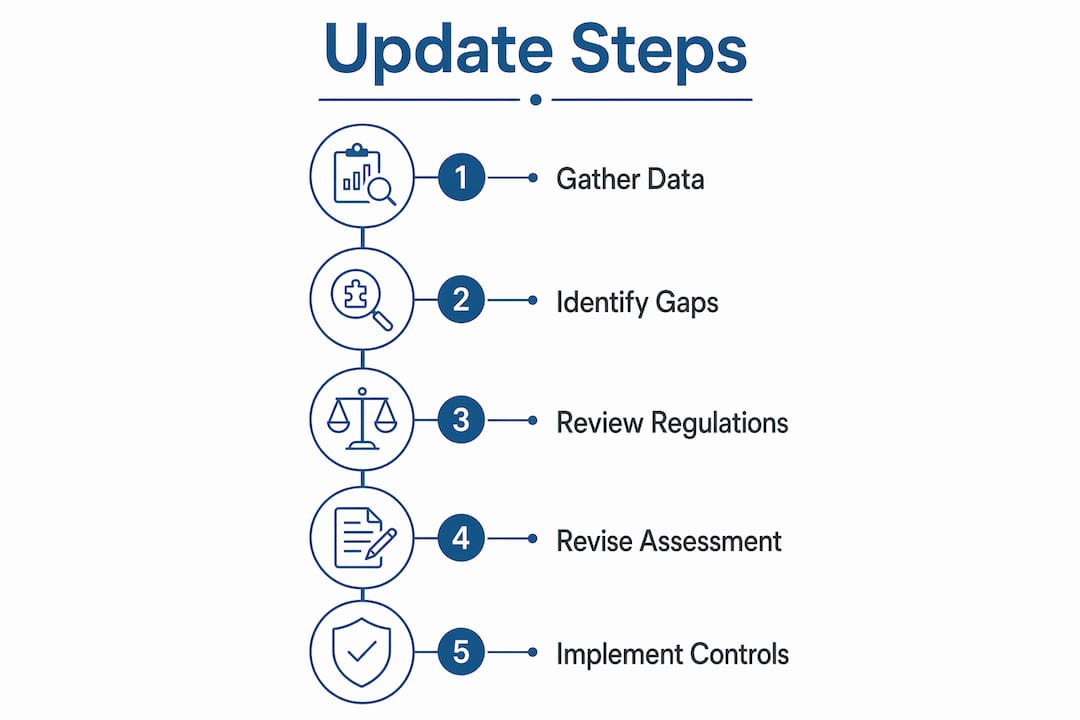
Audit your current assessment against new regulatory requirements. Compare your existing pollutant list, monitoring parameters, and risk conclusions against the updated requirements from Directive 2026/805, HSE L8, or applicable US frameworks. Identify every gap explicitly.
Incorporate effect-based monitoring into your methodology. For EU-regulated facilities, this means adding bioassay-based testing to your monitoring schedule and establishing protocols for interpreting cumulative risk from chemical mixtures. This is a technical step that requires specialist input if your team has not worked with effect-based data before.
Update your Legionella risk assessment to reflect current system conditions. The HSE L8 requirement is that the assessment must be suitable and sufficient under current conditions. Any system change, new evidence, or incident since the last review must be incorporated. For healthcare settings, this is particularly critical given the vulnerability of building occupants.
Revise your operational control programme. This is the step most organisations skip, and it is the step that causes audit failures. Updating assessments without revising treatment setpoints, monitoring frequency, and corrective action workflows leaves the operational programme misaligned with the new risk conclusions.
Document compliance actions with full audit traceability. Every change to the assessment and the operational programme must be recorded with dates, responsible persons, and the regulatory trigger for the change. Risk assessments must synchronise documentation updates with actual operational adjustments to be legally defensible during enforcement inspections.
Train responsible personnel and communicate changes. Updated assessments are only effective if the people responsible for day-to-day controls understand what has changed and why. Role assignments, escalation procedures, and corrective action responsibilities must be clearly communicated.
Schedule the next review trigger. Build review triggers into your operational calendar: regulatory transposition deadlines, system modification protocols, and incident response procedures should all automatically initiate a reassessment.
Requirement area | Previous approach | Updated requirement |
Pollutant monitoring | Single-substance chemical analysis | Cumulative effect-based monitoring including mixtures |
Legionella review frequency | Fixed periodic schedule | Triggered by system changes, incidents, or new evidence |
PFAS compliance (US) | April 2029 MCL deadline | Extended to April 2031 with monitoring remaining enforceable |
Operational programme | Updated separately from assessment | Must be revised in parallel with assessment changes |
Pro Tip: Do not wait for a regulatory deadline to trigger your update. The NJ S2188 implementation experience shows that organisations starting late face compressed timelines for training, controls activation, and monitoring routines. Begin the process at least six months before any fixed deadline.
How to troubleshoot common challenges when updating water risk assessments
The most predictable problems in water risk assessment updates are not technical. They are organisational and procedural.
Documentation-only updates are the single most frequent cause of enforcement action. Revising the written assessment without corresponding changes to the operational control programme creates a paper trail that contradicts actual site practice. Inspectors check both, and the discrepancy is immediately apparent.
Data gaps in effect-based monitoring present a genuine technical challenge for facilities that have never collected bioassay data. The 2026 EU pollutant regime moves assessments towards evaluating combined chemical risks, which requires a different analytical toolkit than most in-house teams currently possess. Engaging a specialist laboratory or consultant at this stage is not optional for EU-regulated facilities.
Timeline pressure is acute for New Jersey facilities under S2188 and for any EU operator who has not yet begun transposition planning. Starting late means compressing the implementation phase, which is where the real compliance work happens. Training, controls activation, monitoring routines, and corrective workflows all take time to embed.
Conflicting jurisdictional requirements affect multinational operators and those with facilities in states with more stringent PFAS rules than the federal framework. The EPA’s PFAS regulatory strategy maintains stringent limits and practical support for affected water systems, but state-level obligations may differ significantly. Mapping each facility to its specific regulatory environment is a prerequisite, not an afterthought.
Regulators do not distinguish between organisations that were unaware of a change and those that chose to ignore it. The compliance obligation exists from the date of enactment, not from the date you discovered it.
Engaging external expertise is not a sign of internal weakness. For complex facilities, healthcare settings, or organisations facing multiple jurisdictional requirements, specialist consultants provide both technical capability and audit credibility. Healthcare water risk assessments in particular require a depth of Legionella-specific knowledge that goes beyond standard environmental compliance.
What are best practices for maintaining compliance with evolving water regulations?
Sustained compliance is an operational discipline, not a project with an end date. The organisations that consistently pass audits treat regulatory updates as inputs to a continuous management process rather than discrete tasks.
Build regulatory monitoring into your compliance calendar. Subscribe to updates from the HSE, the European Commission, and the EPA. Assign a named person to track changes and assess their impact on your current assessments.
Use digital monitoring and automated temperature controls to generate reliable, time-stamped data. Manual records are vulnerable to gaps and inconsistencies that undermine audit credibility.
Integrate chemical mixture risk and Legionella risk into a single assessment framework where possible. The 2026 EU approach to cumulative risk evaluation aligns with the principle that water systems present multiple simultaneous hazards, not isolated ones.
Maintain transparent records and, where required, public reporting. Regulators treat record quality as a proxy for operational quality.
Assign clear roles for every element of the control programme. Ambiguity about who is responsible for a corrective action is a compliance failure waiting to happen.
Anticipate future regulatory updates. The EU transposition deadline of December 2027 is fixed, but the technical guidance underpinning effect-based monitoring will continue to develop. Build flexibility into your assessment methodology.
Pro Tip: Proactive compliance approaches that embed updates into routine operational practices consistently outperform reactive fixes in enforcement outcomes. The cost of a proactive update is a fraction of the cost of a remediation programme triggered by an audit failure or a Legionella incident.
Key takeaways
Updating water risk assessments under changing regulations requires simultaneous revision of both the assessment document and the operational control programme, or the update is not legally defensible.
Point | Details |
Regulatory triggers are multiple | EU Directive 2026/805, HSE L8, EPA PFAS rules, and NJ S2188 each impose distinct update obligations. |
Effect-based monitoring is now required | EU-regulated facilities must move beyond single-substance analysis to cumulative risk evaluation using bioassay methods. |
Operational programmes must be revised in parallel | Updating the assessment document without revising treatment setpoints and monitoring frequency causes audit failures. |
Deadlines are fixed and unforgiving | NJ S2188 requires full implementation by December 2026; EU transposition closes December 2027. |
Proactive integration beats reactive fixes | Embedding regulatory updates into routine operational workflows reduces enforcement risk and protects public health. |
Why I think most organisations are still getting this wrong
The pattern I see repeatedly is organisations treating a water risk assessment update as a document revision exercise. The assessment gets rewritten, the date gets changed, and the file gets closed. Six months later, an inspector arrives and finds that the operational programme still reflects conditions from three years ago. The treatment setpoints have not changed. The monitoring frequency has not changed. The corrective action log is empty. The document says one thing; the site does another.
The regulatory frameworks are actually quite clear on this point. HSE L8 does not ask for a well-written document. It asks for a suitable and sufficient assessment that reflects current conditions and drives current practice. The EU’s move to effect-based monitoring is the same principle applied to chemical risk: the methodology must match the actual hazard profile, not a simplified version of it.
What I find genuinely encouraging in 2026 is the convergence between Legionella risk management and broader chemical risk frameworks. For years, these ran as parallel but separate compliance tracks. The EU’s cumulative risk approach and the increasing sophistication of water management programmes like ASHRAE 188 are pushing them together. Organisations that build integrated frameworks now will be significantly better positioned when the next round of regulatory updates arrives, and there will be a next round.
The facilities that handle this well share one characteristic: they treat compliance as an operational function, not a paperwork function. The assessment is the output of good practice, not a substitute for it.
— Sammi
How Bespokecompliancesolutions supports your water risk assessment updates
Bespokecompliancesolutions provides specialist Legionella and water hygiene compliance services across the UK, designed to align with current HSE L8 requirements and evolving water safety regulations.
Whether you need a bespoke Legionella risk assessment that reflects your current system conditions, water analysis and Legionella testing to support updated monitoring requirements, or system disinfection services to address control failures identified during review, Bespokecompliancesolutions delivers solutions tailored to your specific facilities and regulatory obligations. For commercial premises, the office and commercial compliance service covers the full scope of water risk management from assessment through to ongoing control programme support. Contact Bespokecompliancesolutions to discuss your specific compliance requirements and receive a proposal built around your sites.
FAQ
What triggers a water risk assessment update under HSE L8?
HSE L8 requires a Legionella risk assessment review whenever there is a system change, new evidence of control failure, or reason to believe the existing assessment is no longer valid. There is no fixed minimum review interval; the assessment must remain suitable and sufficient under current conditions at all times.
What is effect-based monitoring and why does it matter for water risk assessments?
Effect-based monitoring uses bioassay methods to detect cumulative risk from chemical mixtures, which traditional single-substance analysis cannot identify. Directive (EU) 2026/805 mandates this approach, meaning EU-regulated facilities must update their monitoring protocols and develop procedures for interpreting bioassay results as part of their risk assessment methodology.
Does the EPA PFAS compliance extension mean monitoring can stop?
No. The EPA’s proposed extension of PFAS PFOA and PFOS compliance deadlines to April 2031 does not suspend monitoring or reporting obligations. Water systems remain subject to enforceable monitoring, reporting, and short-term mitigation requirements throughout any exemption period.
When must New Jersey facilities comply with S2188?
New Jersey S2188 requires water management plan development by 12 September 2026 and full programme implementation by 12 December 2026. Healthcare and complex facilities are most directly affected, and organisations that have not yet begun planning face significant timeline pressure.
What is the most common reason water risk assessment updates fail an audit?
The most frequent cause of audit failure is updating the written assessment without revising the operational control programme. Inspectors examine both documents and site practice. Discrepancies between the assessment’s risk conclusions and the actual treatment setpoints, monitoring frequency, and corrective action records are treated as evidence of non-compliance.
Recommended
Comments