
Water hygiene checks for mixed-use estates: a guide

Water hygiene checks in a mixed-use estate are the structured inspections, temperature monitoring, and sampling routines required to control Legionella bacteria across shared water systems. These checks are not optional. The Health and Safety Executive’s Approved Code of Practice, HSE ACOP L8, places a legal duty on property managers and compliance officers to manage Legionella risk in any building where water is stored or distributed. Mixed-use estates present a particular challenge because residential blocks, retail units, and commercial offices each carry different water usage patterns, occupancy levels, and risk profiles. Getting the approach right across all of them demands a structured, property-specific programme rather than a single blanket policy.
What do water hygiene checks in a mixed-use estate actually require?
Water hygiene checks in a mixed-use estate are defined by HSE ACOP L8 as a risk-based programme of monitoring, maintenance, and record-keeping applied to all water systems under the duty holder’s control. The industry standard term is a “water safety programme,” though property managers commonly refer to the individual tasks as water hygiene checks or a building water hygiene review. Both terms describe the same legal obligation.
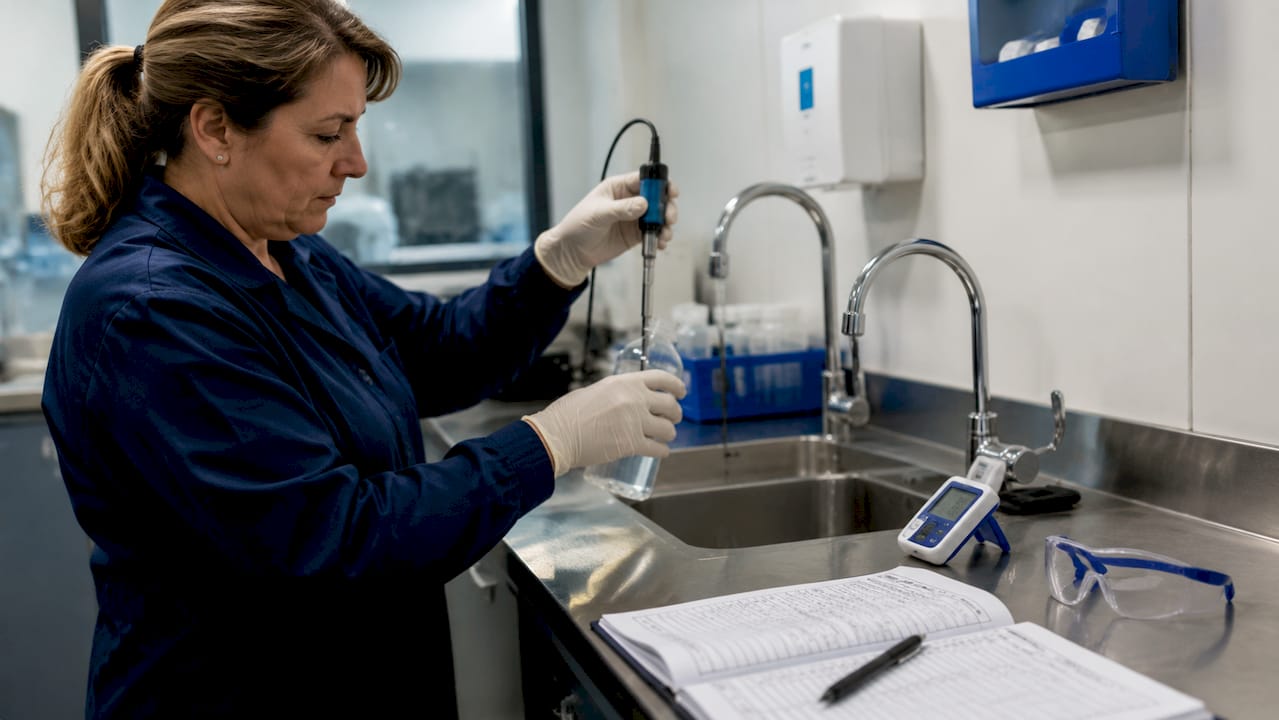
Mixed-use estates require a tiered compliance approach that accounts for different usage patterns across residential, retail, and office areas. A blanket policy applied uniformly across all zones will miss the specific risks that arise in each area. A ground-floor café with high daily throughput carries a very different risk profile from a top-floor residential flat where a tenant may be away for weeks at a time.
The core components of any water hygiene programme are temperature monitoring, outlet flushing, water sampling, and documented record-keeping. Each component must be scheduled, assigned to a named individual, and recorded in a format that survives an audit. Without that structure, compliance exists only on paper.
Prerequisites and tools for effective water hygiene checks
Before any physical checks begin, three things must be in place: a competent Responsible Person, accurate system documentation, and the right equipment.
Appointing the right Responsible Person
The Responsible Person must be technically competent with specific water safety training, not simply appointed as an administrative formality. Simply giving someone the title without the training creates a compliance gap that an HSE inspector will identify immediately. The Responsible Person needs to understand temperature thresholds, sampling protocols, and how to interpret monitoring data. Bespokecompliancesolutions offers Legionella awareness training that meets HSE L8 competency requirements for this role.
Documentation and system schematics
Accurate, up-to-date water system schematics are non-negotiable. For a mixed-use estate, these must cover every building type on site, including all pipework, storage tanks, outlets, and any dead-leg sections. A Written Scheme of Control must also be in place before checks begin. This document sets out what will be monitored, how often, and by whom.
Document | Purpose | Review frequency |
Water system schematic | Maps all pipework, tanks, and outlets | Update on any system change |
Written Scheme of Control | Defines monitoring tasks and ownership | Update on any system or occupancy change |
Legionella risk assessment | Identifies hazards and risk levels | Minimum every two years |
Monitoring logbook | Records all check results and actions | Ongoing, every entry dated and signed |
Equipment checklist
Calibrated digital thermometer with probe for outlet temperature readings
Sterile sample bottles and chain-of-custody forms for water quality assessment
Showerhead removal tools and descaling solution for quarterly maintenance
Personal protective equipment including gloves and eye protection
Access keys or fob records for all zones across the estate
Pro Tip: Calibrate your thermometer against a known reference point at the start of every monitoring visit. A thermometer reading even 2°C low can cause you to pass an outlet that is actually failing its temperature target.
How to conduct water hygiene checks step by step
A structured approach prevents gaps. The following sequence applies across all zones of a mixed-use estate, with adaptations noted where usage type changes the risk level.
Step 1: Temperature monitoring
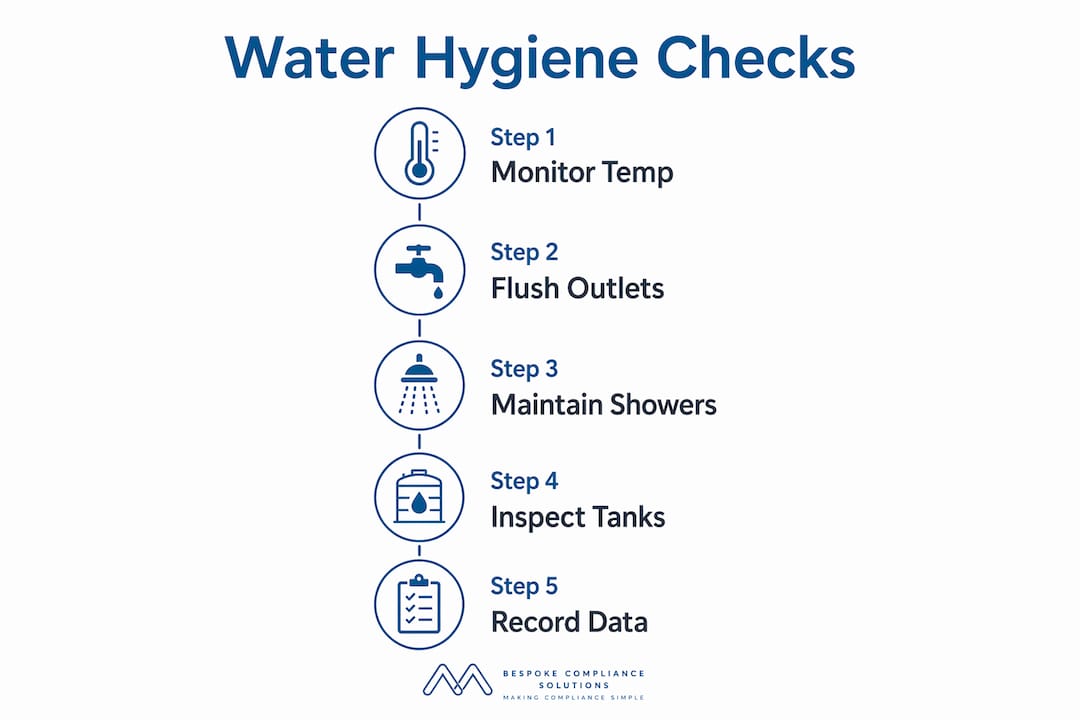
Hot water must be stored at or above 60°C and reach outlets within one minute at 50°C or above. Cold water in distribution must remain below 20°C. These thresholds are not targets to aim for. They are the minimum conditions required to inhibit Legionella growth. Record the temperature at the calorifier, at sentinel outlets (the nearest and furthest from the storage vessel), and at a representative sample of intermediate outlets.
In a mixed-use estate, pay particular attention to zones with irregular occupancy. A retail unit that closes for two weeks over Christmas, or a serviced office suite with low weekend use, creates exactly the stagnation conditions that allow Legionella to proliferate.
Step 2: Outlet flushing
Weekly flushing of rarely used outlets is a mandatory maintenance routine under HSE ACOP L8. Any outlet that has not been used in the previous seven days must be flushed for a minimum of two minutes before the water is used by occupants. In a mixed-use estate, this includes:
Ground-floor retail staff toilets used only during trading hours
Residential communal bathrooms in blocks with high tenant turnover
Commercial kitchen outlets in units between tenancies
Emergency eye-wash stations and hose reels in plant rooms
Log every flush with the date, time, outlet reference, and the name of the person who carried it out. A log with gaps is as damaging as no log at all during an HSE inspection.
Step 3: Showerhead and hose maintenance
Quarterly cleaning and descaling of showerheads and flexible hoses is mandatory. Showerheads generate aerosols, which is the primary route of Legionella exposure. Scale and biofilm inside the showerhead provide a habitat for bacterial growth that temperature control alone cannot address. Remove the showerhead, dismantle it, descale with an appropriate chemical solution, and record the action in the logbook.
Pro Tip: Photograph each showerhead before and after cleaning. The images take seconds to capture and provide clear evidence of condition and action taken, which is exactly what an auditor wants to see.
Step 4: Cold water storage tank inspection
Cold water storage tanks require periodic inspection, cleaning, and disinfection. The tank lid must be secure and insect-proof. The tank interior must be free from sediment, biofilm, and debris. Water entering the tank must be below 20°C. In older mixed-use estates, tanks are often shared across building types, which means a single contamination event can affect residential, retail, and commercial occupants simultaneously.
Step 5: Record all results and actions
Every check, every temperature reading, every flush, and every remedial action must be recorded with a date, time, and named individual. Records must be retained for a minimum of five years. An audit trail with clear ownership is the difference between demonstrating compliance and being unable to defend your position.
Common challenges in mixed-use estate water hygiene compliance
Mixed-use estates create compliance problems that single-use buildings rarely face. Understanding them in advance is the most efficient way to prevent them.
Siloed management among facilities teams is a major compliance risk in mixed-use estates. When the residential block manager, the retail facilities team, and the commercial office landlord each manage their own water systems without communicating, pipework changes go undocumented, and the Written Scheme of Control becomes inaccurate within months of being written.
Dead legs in pipework are unused pipe sections connected to the live system that retain stagnant water. They are a common cause of Legionella outbreaks in older estates and are frequently missed in superficial risk assessments. Dead legs do not appear on outdated schematics, which is why accurate, current documentation is a prerequisite rather than a nice-to-have.
Fluctuating occupancy is another persistent problem. A mixed-use estate with short-term residential lets, seasonal retail tenants, and hot-desking office space can see water usage patterns change dramatically week to week. Monitoring schedules must reflect actual usage, not assumed usage.
Treating routine monitoring data as an early warning system rather than a compliance checkbox is the single most effective shift a property manager can make. Temperature trends, flushing logs, and sampling results tell you where the system is drifting before it fails. Waiting for a positive Legionella sample to act is waiting too long.
When temperature targets are not met, the response must be immediate and documented. Flush the outlet, retest, and if the failure persists, escalate to a specialist. Do not simply re-record the result and move on.
How to maintain ongoing water hygiene compliance
Compliance is not an annual event. It is a continuous process that requires live documentation, scheduled reviews, and trained people.
The Written Scheme of Control must be updated immediately whenever pipework, occupancy, or usage changes occur. Annual reviews alone are insufficient. A new retail tenant fitting out a unit with additional plumbing, or a residential block undergoing a refurbishment, changes the risk profile of the estate overnight.
Key ongoing compliance actions include:
Scheduling a full Legionella risk assessment review at least every two years, or immediately after any significant system change
Conducting training refreshers for the Responsible Person and any staff involved in monitoring tasks
Reviewing trend data from temperature logs and sampling results quarterly to detect early signs of system deterioration
Scheduling remedial works within defined timeframes and documenting completion with evidence
Maintaining a clear audit trail with named ownership for every action
Routine monitoring used proactively detects system health fluctuations before they become emergency remediation events. A calorifier that consistently delivers water at 58°C rather than 62°C is telling you something before it tells the bacteria. Act on the trend, not the threshold breach.
Pro Tip: Set internal alert thresholds 2°C above the legal minimum for hot water and 2°C below the maximum for cold. This gives you a buffer to investigate and act before you are in breach.
Key takeaways
Effective water hygiene management in a mixed-use estate requires a tiered, risk-based programme with live documentation, technically competent people, and proactive use of monitoring data.
Point | Details |
Tiered risk assessment | Apply separate risk profiles to residential, retail, and commercial zones rather than a single blanket policy. |
Temperature thresholds are non-negotiable | Hot water must reach outlets at 50°C or above within one minute; cold distribution must stay below 20°C. |
Flushing and maintenance schedules | Flush unused outlets weekly and clean showerheads quarterly to prevent stagnation and biofilm build-up. |
Live Written Scheme of Control | Update the scheme immediately after any pipework, tenancy, or occupancy change, not just at annual review. |
Competent Responsible Person | Appoint someone with verified water safety training, not just an administrative title. |
What I have learned from managing water hygiene on complex estates
After working across mixed-use estates of all sizes, the pattern I see most often is not ignorance of the rules. Property managers generally know that HSE ACOP L8 exists. The problem is that compliance gets treated as a series of disconnected tasks rather than an integrated system. The residential team flushes their outlets. The commercial team does their temperature checks. Nobody compares notes, and nobody notices that the pipework connecting the two zones has not been on any schematic since the 2009 refurbishment.
The estates that manage this well have one thing in common: a single point of accountability. Not a committee, not a shared inbox, but one named person who owns the Written Scheme of Control, reviews all monitoring data, and has the authority to escalate. That person does not need to carry out every physical check themselves. They need to know what every check result means and what to do when something is wrong.
The other shift I would advocate for is treating temperature data as intelligence rather than paperwork. A log full of passing results that nobody reads is not compliance. It is documentation of compliance theatre. When you start looking at trends across weeks and months, you see the system telling you things. A cold water tank that creeps from 16°C to 19°C over three months is not a problem yet. But it is a warning, and the estates that catch it at 19°C spend far less than the ones that catch it at 22°C with a positive Legionella sample in hand.
Partnering with a specialist for complex estates is not an admission that you cannot manage compliance internally. It is a recognition that the technical depth required, particularly for water quality assessment, sampling interpretation, and dead-leg identification, goes beyond what most in-house teams are trained to deliver. The cost of getting it right is a fraction of the cost of getting it wrong.
— Sammi
How Bespokecompliancesolutions supports mixed-use estate compliance
Mixed-use estates need more than a generic compliance checklist. Bespokecompliancesolutions works directly with property managers and compliance officers across the UK to deliver water hygiene programmes built around the specific risks of each site.
From bespoke Legionella risk assessments for commercial and residential zones to water system disinfection and tank cleaning, every service is tailored to the actual configuration of your estate. Bespokecompliancesolutions also provides logbook implementation, TMV servicing, and ongoing consultancy so your Written Scheme of Control stays accurate as your estate changes. Contact Bespokecompliancesolutions to arrange a site-specific assessment and take the guesswork out of your compliance obligations.
FAQ
What are the legal requirements for water hygiene checks in a mixed-use estate?
HSE ACOP L8 requires duty holders to implement a written risk assessment and control programme for all water systems under their management. Mixed-use estates must apply this to every building type on site, including residential, retail, and commercial zones.
How often should water hygiene checks be carried out?
Temperature monitoring at sentinel outlets should occur monthly as a minimum. Unused outlets require weekly flushing, showerheads and hoses require quarterly cleaning, and a full Legionella risk assessment review is required at least every two years or after any significant system change.
What temperature thresholds apply to hot and cold water systems?
Hot water must be stored at 60°C or above and reach outlets at 50°C or above within one minute. Cold water in distribution must remain below 20°C to inhibit Legionella growth.
What is a dead leg and why does it matter for Legionella compliance?
A dead leg is an unused section of pipework connected to the live water system. Dead legs retain stagnant water and create bacterial growth hotspots. They are a common cause of Legionella outbreaks in older mixed-use estates and are frequently missed in basic risk assessments.
Who is responsible for water hygiene compliance in a mixed-use estate?
The duty holder, typically the property owner or managing agent, must appoint a technically competent Responsible Person with verified water safety training. Administrative appointment without technical competency does not satisfy the HSE ACOP L8 requirement.
Recommended
Comments