
Watteco.com alternatives for UK IoT projects in 2026
- 7 days ago
- 5 min read

The strongest alternatives to Watteco for UK IoT deployments
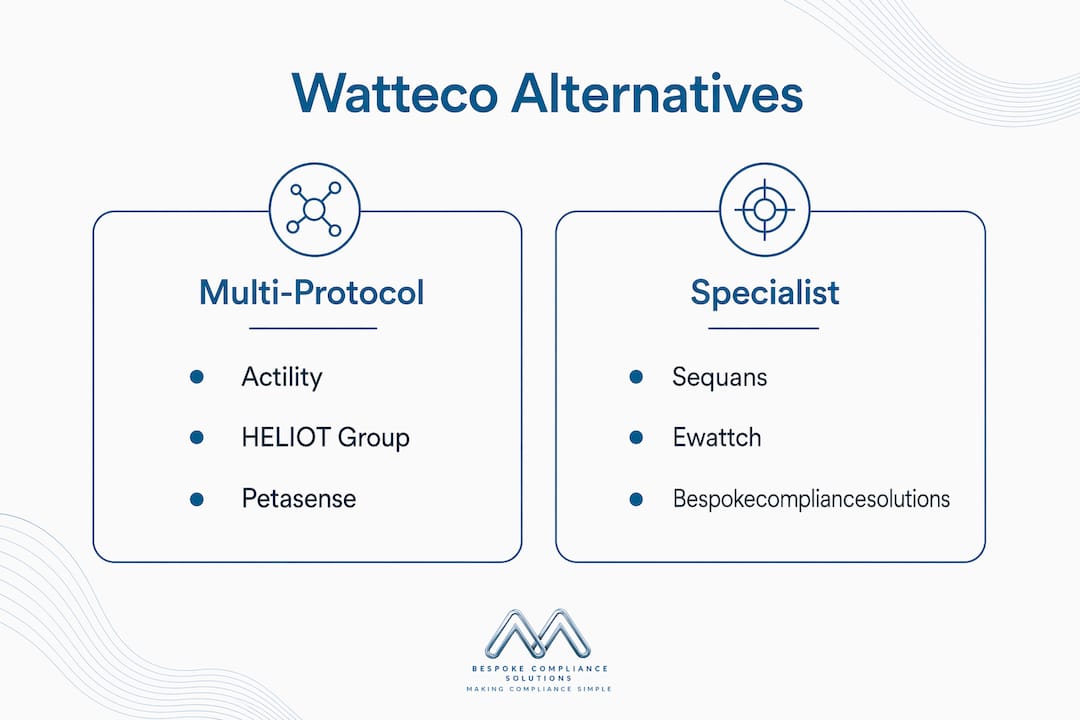
Watteco’s multi-protocol sensor hardware, covering LoRaWAN, SigFox, and Wireless M-Bus, sets a high bar for harsh-environment IoT. The good news is that several credible alternatives serve the UK market across smart buildings, industrial monitoring, and utility applications. Here is a concise shortlist to orient your search:
Actility — LPWAN connectivity platform with strong UK presence and multi-protocol gateway support
GradeSens — predictive maintenance sensors with integrated analytics for manufacturing and energy
Ewattch — energy management sensors and software purpose-built for smart buildings
HELIOT Group — end-to-end European IoT infrastructure including network services and consulting
Petasense — wireless sensors for industrial asset reliability in harsh environments
ELA Innovation — Bluetooth IoT sensors for industrial temperature and access monitoring
Sequans Communications — 4G and 5G cellular IoT semiconductor modules for wide-area deployments
Seniton Technology / Seniton Technology Corporation — commercial wireless IoT equipment for general civilian and commercial applications
Each sits in a different part of the market. Choosing the wrong one for your deployment context costs more than the hardware price suggests, particularly when protocol mismatches force a full re-commissioning.
How do these Watteco competitors compare on technical criteria?
The top Watteco competitors differ sharply on protocol support, target environment, and integration depth. One table covers the ground quickly.
Provider | Specialisation | Protocols supported | Best for | Harsh/secure environments |
LPWAN connectivity and IoT platforms | LoRaWAN, multi-protocol | Smart buildings, industrial | Yes | |
Predictive maintenance analytics | Wireless sensor networks | Manufacturing, energy, logistics | Moderate | |
Energy management IoT | LoRaWAN, Modbus | Smart building energy efficiency | Moderate | |
End-to-end IoT infrastructure | LoRaWAN, NB-IoT, LTE-M | Digitalisation projects | Yes | |
Industrial asset reliability | Wireless proprietary mesh | Industrial asset monitoring | Yes | |
Bluetooth industrial sensors | Bluetooth Low Energy | Industrial controls, access | Moderate | |
Cellular IoT semiconductors | LTE Cat-M, NB-IoT, 5G | Wide-area cellular IoT | Yes | |
Seniton Technology | Commercial wireless IoT equipment | Wireless (various) | General commercial applications | Low |
Seniton Technology Corporation | Commercial wireless IoT equipment | Wireless (various) | General commercial applications | Low |
Actility and HELIOT Group come closest to Watteco’s breadth, supporting multiple LPWAN protocols and offering UK-accessible network services. Petasense is the clearest choice for industrial brownfield sites where wireless vibration monitoring in dirty or high-temperature conditions is the priority. ELA Innovation fills a specific gap: Bluetooth-based door and temperature sensors where short-range connectivity is sufficient and battery longevity matters more than range.

Sequans operates at a different layer entirely. Rather than selling finished sensor units, it supplies the cellular modules that other manufacturers embed, making it relevant when you are specifying devices for wide-area NB-IoT or LTE-M deployments rather than buying off-the-shelf hardware.
For smart building energy management specifically, Ewattch pairs sensor hardware with its own software layer, which reduces integration effort but limits flexibility if you already run a building management system. OpenRemote, an open-source platform purpose-built for facility and energy teams, is worth evaluating alongside Ewattch if you want a software layer you can modify.
What should you check before committing to a Watteco alternative?
Protocol compatibility is the first filter, not the last. Deploying sensors that cannot talk to your existing gateway or cloud backend creates an integration bottleneck that no amount of vendor support resolves quickly. Differentiating between hardware sensor providers and software platform vendors is critical here: a hardware provider must be verified for protocol compatibility with your backend before any purchase order is raised.
The second filter is certification. For industrial or utility environments, IP67 or IP68 ingress protection ratings and, where explosive atmospheres are present, ATEX certification are non-negotiable. Switching providers without checking these ratings can result in premature sensor failure and costly compliance revalidation.
Total cost of ownership is routinely underestimated. Low-cost sensors lacking dynamic bandwidth adaptation can deplete batteries far faster than optimised LPWAN devices, increasing maintenance frequency on remote assets. Factor in battery replacement cycles, not just unit cost.
Pro Tip: Insist on protocol-agnostic middleware or an open-source platform layer such as ThingsBoard or EdgeX Foundry between your sensors and your application. Proprietary cloud lock-in is the biggest long-term risk when switching providers, and it is far cheaper to address at design stage than after deployment.
Core buying criteria to work through before signing a contract:
Confirm sensor protocol matches your existing gateway and cloud backend
Verify IP rating and ATEX certification for the specific deployment environment
Assess vendor’s UK support capability and response time commitments
Request a proof-of-concept trial covering your actual operating conditions
Calculate total cost of ownership including battery replacement and firmware update cycles
Check data sovereignty: where is sensor data stored, and does it meet UK GDPR requirements?
Evaluate migration costs if you are moving from an existing Watteco estate
Technical vetting: what the analysts and field experience say
The most common failure mode in IoT platform migration is not hardware incompatibility. It is the assumption that swapping sensor hardware is all that is required. Migrating often entails testing software integration, validating vendor support processes, and re-certifying the system against site-specific compliance requirements.
Gartner Peer Insights consistently shows that buyers who evaluate IoT platforms on integration and deployment criteria, rather than feature lists alone, report fewer post-deployment issues. The evaluation categories that matter most are integration depth, service and support quality, and specific protocol capabilities.
Power consumption deserves more scrutiny than most procurement teams give it. Dynamic bandwidth features in specialised sensors prolong battery life by adjusting data transmission frequency to signal conditions, a capability that directly affects maintenance cycles on remote or hard-to-access assets.
Vetting for certifications such as IP67/IP68 and ATEX is critical in ensuring sensor suitability for hazardous or harsh industrial environments. Skipping this step risks costly compliance revalidation after deployment, not before it.
For healthcare and facilities management contexts, where water system monitoring intersects with IoT sensor deployment, the stakes around certification and data reliability are particularly high. Bespokecompliancesolutions works with facilities teams across the UK on automated temperature monitoring for Legionella compliance, a use case where sensor reliability and audit-ready data logging are as important as the underlying protocol.
Bespokecompliancesolutions: water hygiene compliance alongside your IoT infrastructure
If your IoT monitoring project includes water systems, Bespokecompliancesolutions offers a specialist route that sits alongside your sensor infrastructure rather than replacing it.
Where IoT platforms handle data collection, Bespokecompliancesolutions handles the compliance layer that UK facilities managers are legally required to maintain. Services include bespoke Legionella risk assessments across Coventry, Binley, Caludon, Canley, and Allesley, water sampling and analysis, Legionella awareness training, and TMV servicing. For sites already running automated temperature monitoring, Bespokecompliancesolutions integrates that data into a structured compliance programme rather than treating it as a standalone feed. Reach out to discuss how sensor data from your building can support a fully documented water hygiene control programme.
Key takeaways
Actility, HELIOT Group, and Petasense are notable like-for-like alternatives to Watteco for UK deployments requiring multi-protocol LPWAN or industrial-grade sensor reliability.
Point | Details |
Protocol compatibility first | Verify sensor protocols match your existing gateway before any purchase; mismatches force costly re-commissioning. |
Certification is non-negotiable | IP67/IP68 and ATEX ratings must be confirmed for industrial or utility environments before deployment. |
Battery costs are hidden | Sensors without dynamic bandwidth adaptation drain faster, raising long-term maintenance costs on remote assets. |
Avoid proprietary lock-in | Use open-source middleware such as ThingsBoard or EdgeX Foundry to retain flexibility across multi-vendor sensor estates. |
Bespokecompliancesolutions | Provides the Legionella compliance layer for UK facilities running automated water temperature monitoring alongside IoT infrastructure. |
Recommended
Comments