
What is a duty of care compliance record?

A duty of care compliance record is a formal set of documents proving that an organisation has taken reasonable, proactive steps to manage foreseeable risks and protect everyone affected by its operations. In legal terms, these records constitute your primary defence against negligence claims by demonstrating that your organisation met the standard expected of an ordinarily prudent person. They are not simply administrative paperwork. They are the documented narrative of how your organisation identifies, assesses, and controls risk. For compliance officers and business owners across sectors, from healthcare to facilities management, understanding what these records contain and why they matter is the foundation of sound governance.
What is a duty of care compliance record and why does it matter legally?
A duty of care compliance record is defined as the body of documentation that evidences an organisation’s fulfilment of its legal and ethical obligations to prevent harm. Under common law and UK health and safety legislation, duty of care requires reasonable care to avoid foreseeable harm. Critically, it does not guarantee complete safety. It mandates proactive risk management judged against what a reasonably prudent organisation would do in the same circumstances.
This distinction matters enormously in practice. Many business owners mistakenly believe that if an accident occurs, they have automatically failed their duty of care. The law does not work that way. What courts and regulators examine is whether your organisation took reasonable steps beforehand. Your compliance records are the proof of those steps.
The legal framework for negligence claims rests on four elements: duty, breach, causation, and loss. Detailed record-keeping targets the breach element directly. If your records demonstrate that you identified a risk, assessed it, implemented controls, and monitored the outcome, it becomes substantially harder for a claimant to prove that you breached your standard of care. This is why compliance documentation is not optional. It is your organisation’s most reliable legal shield.
“Records must document proactive risk mitigation steps, not just the absence of accidents. The question is always: what would an ordinarily prudent organisation have done, and did you do it?”
Beyond legal defence, these records demonstrate organisational accountability. Regulators, insurers, and auditors all assess your compliance posture through the quality and completeness of your documentation. Organisations that maintain thorough records signal a mature approach to risk management, which directly reduces business exposure and liability.
What should a duty of care compliance record include?
Effective compliance records include audit trails, policy acknowledgements, training certifications, process validations, maintenance logs, and incident archives. Each document type serves a specific evidential purpose, and together they build the complete picture of your compliance activity.

The table below summarises the core record types, their purpose, and how frequently they should be updated.
Record type | Purpose | Update frequency |
Risk assessments | Identify and evaluate foreseeable hazards | Annually or after significant change |
Training certificates | Evidence that staff are competent to manage risks | On completion and renewal |
Maintenance and inspection logs | Prove that systems and equipment are kept in safe condition | Per inspection schedule |
Incident and near-miss reports | Document what occurred, the response taken, and lessons learned | Immediately after each event |
Audit trails and policy acknowledgements | Show that procedures were communicated, understood, and followed | Ongoing, with version control |
Cleaning and disinfection records | Confirm that hygiene controls were carried out as required | Per control programme schedule |
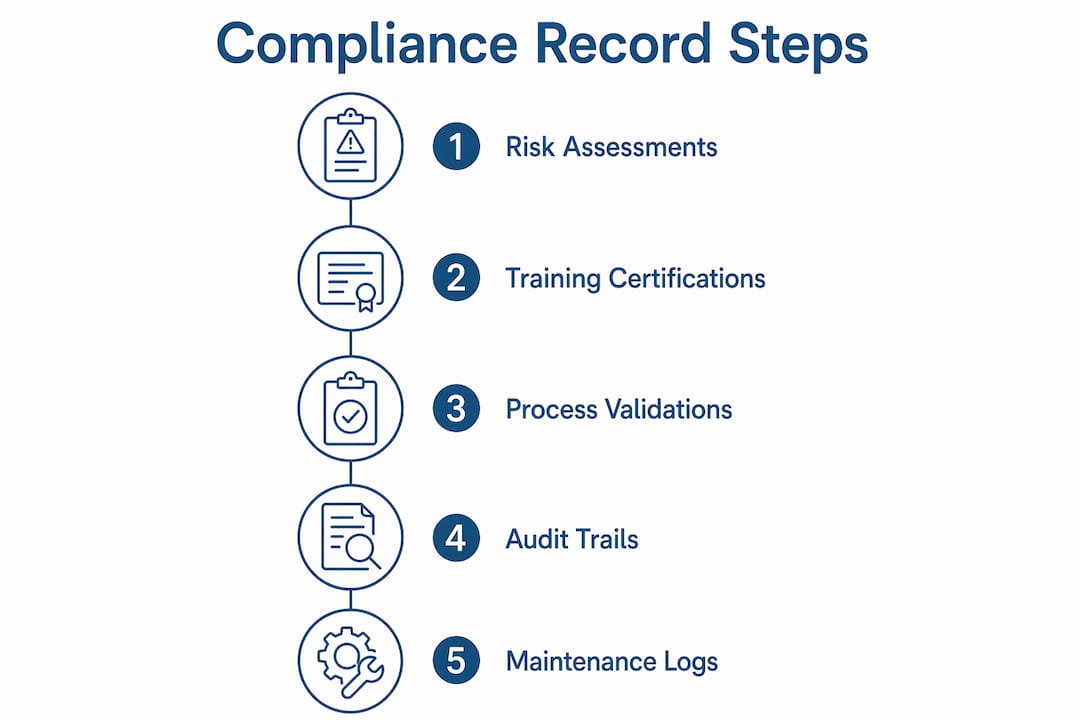
For organisations managing water systems, a legionella logbook is a practical example of how these record types are consolidated into a single, auditable system. It captures temperature monitoring results, water sampling outcomes, disinfection records, and remedial actions in one place.
One distinction that causes persistent confusion is the difference between a legal compliance register and compliance records. Legal registers list applicable laws and obligations. Compliance records demonstrate actual adherence to those obligations. Think of the register as the skeleton of your compliance framework and the records as the muscle that proves actions were carried out. Treating them as the same document leads to audit failures and legal vulnerabilities.
Pro Tip: Map each obligation in your legal register directly to the specific compliance record that evidences it. This traceability means that during an audit, you can move instantly from a legal requirement to the proof of performance, rather than searching across disconnected files.
Version control is equally non-negotiable. Records that cannot demonstrate when they were created, who reviewed them, and what changed between versions carry significantly less evidential weight. Automated retention schedules prevent records from being deleted prematurely and protect your organisation in the event of a claim arising years after the fact.
How to maintain and update duty of care compliance records effectively
Maintaining records is not a one-off task. It is a continuous process that requires defined ownership, scheduled reviews, and the right tools to prevent records from becoming outdated as your operations evolve. Compliance drift, where records fall behind operational reality because of process changes, staff turnover, or system upgrades, is the most common failure mode in compliance programmes.
A structured approach to record management follows these steps:
Define ownership. Assign a named individual or team responsibility for each record type. Unowned records are never updated.
Set review cycles. Establish minimum review frequencies for each document, typically annually for risk assessments and immediately after incidents or significant operational changes.
Use version control. Every revision should carry a date, author, and summary of changes. Digital document management systems make this automatic.
Implement automated alerts. Configure your compliance software to flag records approaching their review date. Waiting until a record has expired is too late.
Conduct periodic audits. Schedule internal audits at least annually to cross-reference your legal register against your compliance records and identify gaps.
Integrate with broader risk management. Compliance records should feed into your organisation’s risk register, not sit in isolation. A gap in one should trigger a review in the other.
A structured approach to drafting, reviewing, and storing documents using standard templates ensures traceability and consistency across your organisation. Templates reduce the risk of records being created in incompatible formats that cannot be cross-referenced during an audit.
In 2026, digital compliance platforms offer features including automated retention schedules, digital signatures, and centralised dashboards that give compliance officers a real-time view of record status across multiple sites. For organisations managing several premises, such as housing associations or facilities management companies, this visibility is the difference between controlled compliance and reactive fire-fighting.
Pro Tip: When reviewing a legionella risk assessment or any site-specific compliance record, document not just what was found but what action was taken and by when. An undated, unactioned finding is worse than no finding at all in a legal context.
How do duty of care compliance records support audits and risk management?
Compliance documentation provides transparent evidence of compliance activities to auditors and regulators. When an inspector from the Health and Safety Executive or an internal auditor arrives, your records are the primary source of evidence. The quality of those records determines whether the audit is a straightforward process or a protracted investigation.
The following record types map directly to typical audit requirements:
Risk assessments: Auditors verify that hazards were identified, evaluated, and controlled before harm occurred.
Training records: Inspectors confirm that staff responsible for managing risks hold current, relevant qualifications.
Maintenance and inspection logs: Regulators check that equipment and systems were serviced on schedule and that any defects were remedied promptly.
Incident reports: Auditors assess whether incidents were investigated thoroughly and whether corrective actions were implemented and verified.
Disinfection and water quality records: For water hygiene compliance, these records demonstrate that control measures were carried out in line with the HSE legionella regulations and your site-specific control programme.
Beyond defending against claims, compliance records play a direct role in continuous improvement. When records are reviewed systematically, patterns emerge. Recurring near-misses in a particular area signal a control failure before it becomes an incident. Tabletop exercises and crisis simulations recorded in compliance logs provide stronger evidence of safety culture maturity than basic maintenance logs alone. Regulators and courts recognise the difference between an organisation that records what happened and one that records what it learned and changed as a result.
Mapping your legal register to specific compliance documentation creates traceability that allows any legal obligation to be supported by direct evidence of task completion. This integration transforms your compliance records from a passive archive into an active governance tool.
Key takeaways
A duty of care compliance record is the documented proof that your organisation took reasonable, proactive steps to manage risk, and it is your primary defence in any negligence claim.
Point | Details |
Definition is precise | A compliance record evidences fulfilment of duty of care obligations, not merely the absence of accidents. |
Legal defence is the core purpose | Records targeting the breach element of negligence claims reduce organisational liability significantly. |
Registers and records are different | Legal registers list obligations; compliance records prove those obligations were met through specific actions. |
Compliance drift is the main risk | Automated review cycles and version control prevent records from becoming outdated and legally indefensible. |
Audit readiness requires integration | Mapping records to your legal register and risk register creates traceability that satisfies regulators and courts. |
Why I think most organisations are getting this wrong
After working across commercial, healthcare, and facilities management sectors, the pattern I see most often is organisations that have records but cannot use them. They have folders of documents, spreadsheets of inspection dates, and training certificates filed somewhere. But when an auditor asks them to demonstrate that a specific legal obligation was met on a specific date, the search begins. That search is the problem.
The organisations that genuinely protect themselves treat their compliance records as a narrative. Every record tells part of the story of how risk was managed. When you approach documentation that way, you naturally ask different questions. Not “have we got a record?” but “does this record tell the full story of what we did and why?” The health and safety manager’s role in water risk is a good example of this. The best managers I have worked with do not just log temperature checks. They document what the result meant, what action it triggered, and who verified the outcome.
The other mistake I see regularly is conflating the legal compliance register with the compliance record itself. The register tells you what you must do. The record proves you did it. Confusing the two leaves a gap that only becomes visible when something goes wrong. By then, it is too late to fill it.
Technology helps, but it does not solve a cultural problem. If the people responsible for creating records do not understand why those records matter, no software will save you. Invest in training. Make sure your team understands that a well-maintained compliance record is not bureaucracy. It is protection, for them and for the organisation.
— Sammi
How Bespokecompliancesolutions can support your compliance records

Bespokecompliancesolutions works with commercial premises, healthcare facilities, housing associations, and property managers across the UK to build compliance records that are audit-ready and legally defensible. From legionella compliance for offices to water testing and analysis that feeds directly into your compliance documentation, every service is designed to make your duty of care obligations straightforward to evidence. The team also implements bespoke logbook systems tailored to your sites, so your records are structured, traceable, and ready when regulators or auditors need them. Contact Bespokecompliancesolutions to discuss a compliance programme built around your organisation’s specific obligations.
FAQ
What is a duty of care compliance record?
A duty of care compliance record is a formal set of documents evidencing that an organisation has taken reasonable, proactive steps to identify and manage foreseeable risks. It serves as the primary legal defence against negligence claims by demonstrating that the required standard of care was met.
How is a compliance record different from a legal register?
A legal register lists the laws and obligations that apply to your organisation. A compliance record proves that those obligations were actually fulfilled through specific, documented actions. Treating them as the same document creates traceability gaps that auditors and courts will identify.
What records should be included in a duty of care compliance file?
Core records include risk assessments, training certificates, maintenance and inspection logs, incident reports, audit trails, and disinfection or cleaning records. Each type evidences a different aspect of your compliance activity and together they build a complete picture for auditors and regulators.
How often should duty of care compliance records be updated?
Risk assessments should be reviewed at least annually or after any significant operational change. Maintenance logs and inspection records should be updated per your control programme schedule. Incident reports must be completed immediately after each event, with corrective actions documented and verified.
What happens if compliance records are incomplete during an audit?
Incomplete records make it substantially harder to defend against a breach of duty claim, because the burden shifts to proving that reasonable steps were taken without documentary evidence. Regulators such as the Health and Safety Executive treat gaps in records as indicators of a broader compliance failure, which can result in enforcement action.
Recommended
Comments