
Dental unit waterline disinfection best practices
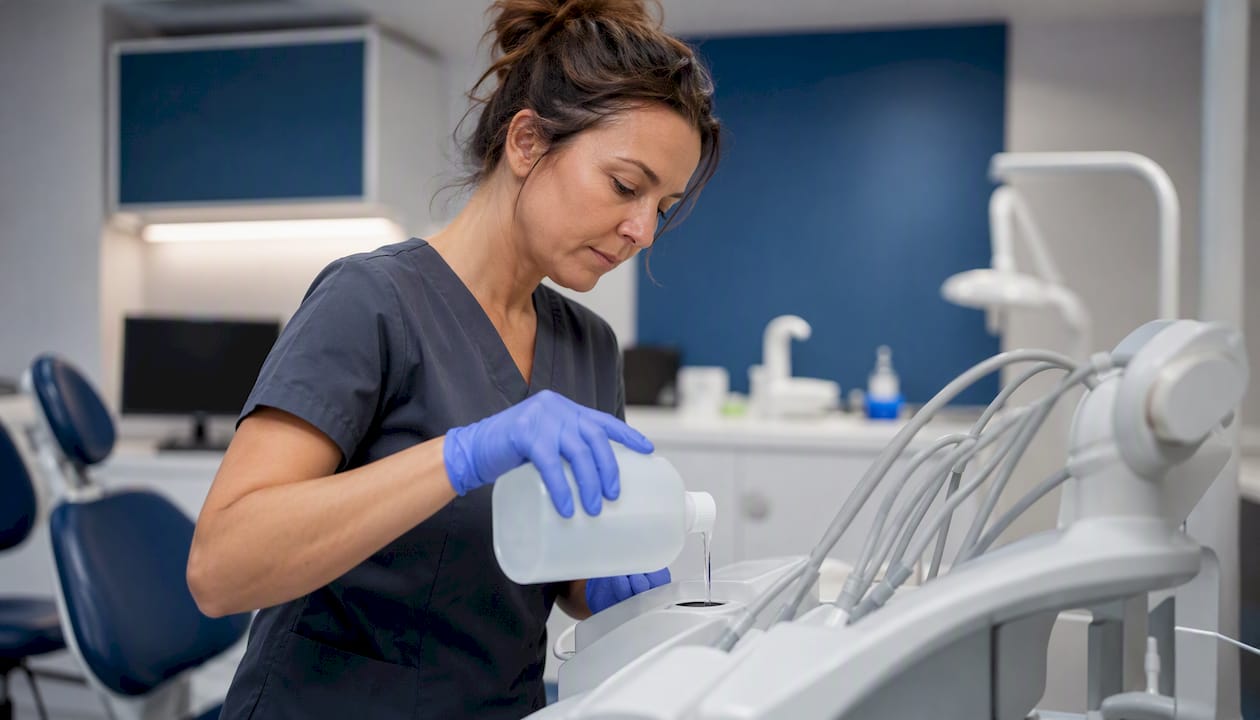
The protocol that protects patients and satisfies CQC inspection comes down to four non-negotiables: flush every handpiece and air-water syringe for at least two minutes at the start of each clinical session, purge for a short period between patients, maintain continuous or scheduled chemical treatment to keep heterotrophic plate count (HPC) at or below ≤500 CFU/mL, and use only sterile irrigants for any surgical procedure. If your last microbiological result exceeded that threshold, shock-disinfect today and retest before resuming clinical use.
Start here — immediate actions for your practice:
Flush all dental unit waterlines (DUWLs) for two minutes before the first patient of the day and at the end of the session
Purge handpieces and syringes for 20–30 seconds between every patient
Check your independent reservoir or bottle for correct chemical concentration and expiry
Confirm your last microbiological sample date; if it is more than three months ago, schedule one now
Review your shock-disinfection log; if no entry exists in the past six months, plan a treatment this week
Verify that surgical lines are supplied with sterile water or saline, not mains-fed DUWL water
Pro Tip: If your HPC result has just come back above 500 CFU/mL, do not wait for the next scheduled maintenance cycle. Perform a shock disinfection immediately, allow the full contact time, flush thoroughly, and retest before the unit returns to clinical use.
Table of Contents
Why does DUWL contamination matter for infection control?
Dental unit waterlines are narrow-bore plastic tubing, typically 1–2 mm in internal diameter, with intermittent flow and frequent periods of stagnation. Those conditions are almost ideal for biofilm formation. Within days of installation, bacteria attach to the inner surface, secrete a protective polysaccharide matrix, and establish a community that is orders of magnitude more resistant to disinfectants than free-floating planktonic cells.
The pathogens of concern include:
Legionella pneumophila (aerosol exposure risk during ultrasonic scaling and air-water syringe use)
Pseudomonas aeruginosa (opportunistic infection risk in immunocompromised patients)
Mycobacterium spp. (non-tuberculous mycobacteria, linked to post-surgical infections)
Staphylococcus aureus and heterotrophic bacteria generally (indicators of overall water quality)
The clinical risk is not theoretical. Aerosolised water from handpieces and scalers reaches the patient’s mouth, eyes, and respiratory tract, and the dental team’s breathing zone. For surgical procedures, contaminated irrigation fluid contacts exposed bone and tissue directly. Legionella surveillance data from across Europe reinforces why healthcare water systems, including dental premises, require active risk management rather than passive monitoring.
Benchmark: The CDC and ADA both set ≤500 CFU/mL of heterotrophic bacteria as the operational target for routine dental water, aligned with the US Environmental Protection Agency’s drinking-water safety guidelines. Sterile irrigants are required for all surgical procedures regardless of routine water quality results.
The FDA confirms that dental unit waterlines cannot be reliably sterilised by any currently available method, which is why ongoing treatment and monitoring are the only credible control strategy.
What UK regulations and standards apply to dental waterlines?
Duty-holder responsibilities
In a UK dental practice, the registered manager and practice owner share duty-holder status for water safety. That means they are legally responsible for ensuring a documented risk assessment is in place, that control measures are implemented and recorded, and that staff are trained to carry them out. The gov.uk decontamination guidance for primary care dental practices requires explicit, auditable SOPs and links DUWL management directly to wider decontamination and infection control expectations.
Key guidance documents
Document | What it requires in practice |
Documented DUWL management SOP, manufacturer IFU alignment, evidence of monitoring | |
Health and Social Care Act Code of Practice (CQC) | Infection prevention and control policy covering water safety; inspection evidence required |
Legionella risk assessment, written scheme of control, and monitoring records for all water systems on premises | |
HTM 04-01 | Water safety in healthcare premises; plumbing design, dead-leg avoidance, temperature control |
gov.uk Hot and Cold Water Supply Guidance | Storage and distribution design to minimise stagnation and biofilm risk |
HTM 01-05 is the primary clinical standard for dental decontamination in England. It does not set a separate DUWL microbiological limit but directs practices to follow manufacturer instructions and maintain evidence of compliance. CQC inspectors use it as the benchmark when reviewing infection control records. HSG274 applies to any premises where water systems could harbour Legionella, which includes dental surgeries, and it requires a written Legionella risk assessment, a named responsible person, and a logbook of control measures.
Pro Tip: Align your HTM 04-01 compliance obligations with your DUWL SOP from the outset. A single integrated water safety plan covering both the dental unit lines and the wider building water system is far easier to audit than two separate documents.
What should your daily, weekly and monthly DUWL schedule include?
Biofilm does not take a day off, so neither can your maintenance schedule. The following routine is built around the ADA’s flushing recommendations and the operational requirements of HTM 01-05.
Weekly and monthly tasks
Check chemical cartridge levels or tablet-dosing systems and replace before they run out
Inspect inline filters for blockage or discolouration; replace per manufacturer schedule (typically every one to three months)
Review the maintenance logbook for any missed entries or anomalies
Monthly: inspect handpiece connections and tubing for visible biofilm, cracking, or discolouration
Quarterly (minimum): submit a water sample for independent microbiological analysis
Pro Tip: Before adding any chemical treatment to your system, cross-reference the product with your dental unit manufacturer’s instructions for use (IFU). Some oxidising agents can degrade internal seals or void the unit warranty. The OSAP white paper recommends documenting this compatibility check as part of your SOP.
Which disinfection strategy is right for your dental unit?
There is no single correct approach. The right strategy depends on your unit’s design, the manufacturer’s IFU, your patient throughput, and your monitoring results. The three main categories each have a distinct operational profile.
Continuous low-level chemical dosing
A measured concentration of disinfectant, typically a silver-stabilised hydrogen peroxide, chlorine dioxide, or citric acid-based product, is maintained in the independent reservoir or inline dosing system throughout the clinical day. The advantage is consistent suppression of planktonic bacteria and early-stage biofilm. The limitation is that it does not eliminate established biofilm on its own; a shock treatment is still needed periodically to reset the system.
Monitoring is straightforward: test the reservoir concentration at the start of each session with the appropriate test strip, and submit quarterly microbiological samples to confirm the system is performing.
Intermittent shock disinfection
A high-concentration disinfectant is applied for a defined contact time, typically overnight or over a weekend, to kill established biofilm. This is the method of choice when routine monitoring shows rising HPC counts, when a unit has been idle for more than 72 hours, or as a scheduled quarterly reset even when results are within range. The chemistry varies: hydrogen peroxide-based products are common, but some manufacturers specify alternative chemistries. Always check compatibility before use.
Physical and automated options
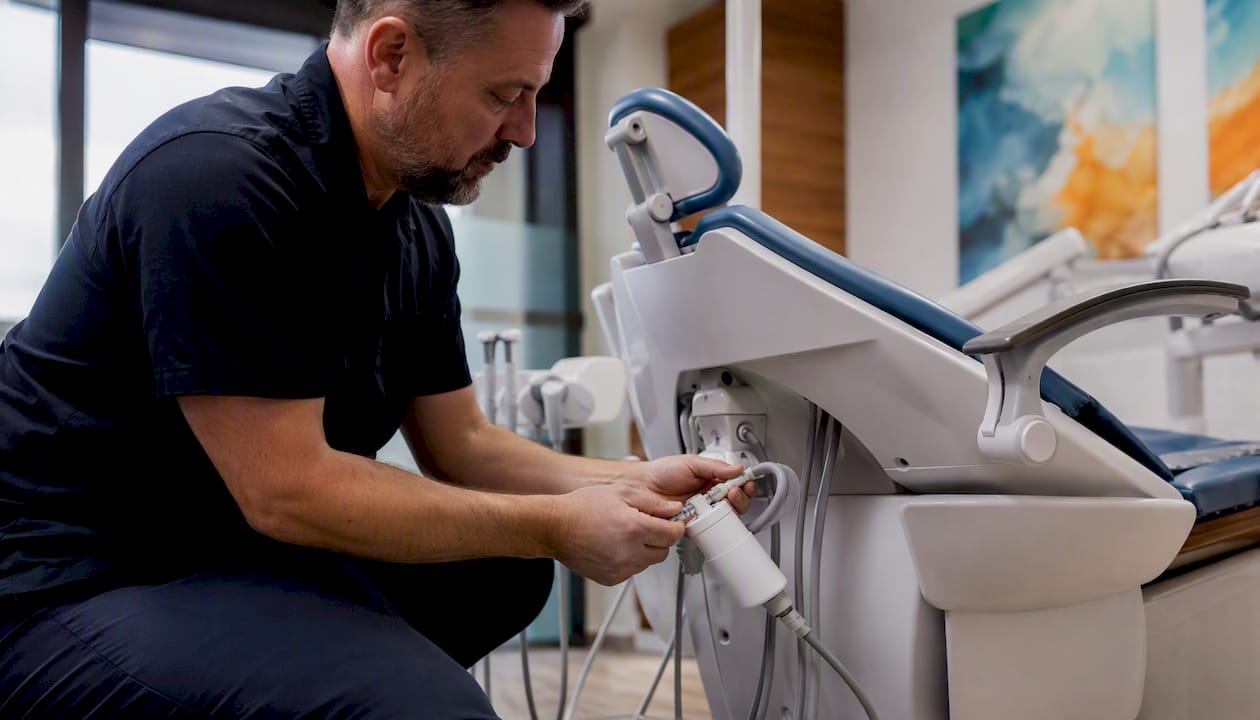
Independent water reservoirs (bottle systems) physically isolate the unit from mains water, removing the primary source of incoming contamination. Inline filtration at the point of use can reduce microbial load at the outlet. Automated dosing units remove the human error element from concentration management. These are not substitutes for chemical treatment but work best in combination with it.
Method | Efficacy vs established biofilm | Maintenance burden | Cost | Monitoring needs |
Continuous chemical dosing | Moderate (suppression) | Low-medium (daily concentration check) | Ongoing consumable cost | Quarterly microbiological sampling |
Intermittent shock disinfection | High (when correctly applied) | Low (periodic, scheduled) | Periodic product cost | Retest after each shock treatment |
Independent reservoir only | Low-moderate (removes mains input) | Medium (daily fill/drain) | Low ongoing | Quarterly microbiological sampling |
Inline point-of-use filtration | Moderate (outlet protection) | Medium (filter replacement) | Filter replacement cost | Quarterly microbiological sampling |
Automated dosing system | High (consistent concentration) | Low (cartridge replacement) | Higher capital, lower labour | Quarterly microbiological sampling |
Pro Tip: The FDA’s guidance is explicit: deviations from the manufacturer’s validated reprocessing instructions risk both device damage and reduced disinfection efficacy. Keep a copy of the IFU in your logbook and note the specific products it approves.
How to perform a shock disinfection: a step-by-step SOP
This procedure applies to independent reservoir systems. For mains-connected units, consult your manufacturer’s IFU before proceeding, as the isolation steps differ.
Before you begin, check:
The disinfectant product is compatible with your specific dental unit (confirm against manufacturer IFU)
Amalgam separators are isolated or bypassed if using an oxidising agent, as per best management practice guidance
Adequate ventilation is available in the surgery
PPE is ready: chemical-resistant gloves, eye protection, and an apron
Shock disinfection procedure:
Empty and rinse the independent reservoir; discard any residual treatment solution
Prepare the shock-concentration solution according to the product label (typically a higher concentration than the daily maintenance dose); measure accurately
Fill the reservoir with the shock solution and attach it to the unit
Run the solution through each handpiece line, air-water syringe, and ultrasonic scaler until the solution is visible at the outlet
Close off the lines and allow the full contact time specified by the product manufacturer (commonly 10–60 minutes, but verify against the product IFU)
After contact time, flush each line thoroughly with fresh water for a minimum of two minutes per outlet to remove all residual disinfectant
If the product requires neutralisation before disposal, prepare and apply the neutralising agent; dispose of waste in accordance with your practice’s chemical waste procedure and local trade effluent consent
Refill the reservoir with freshly prepared maintenance-concentration solution
Log the date, product used, batch number, concentration, contact time, and the name of the person who performed the procedure
Submit a water sample for microbiological analysis no earlier than 48 hours after treatment; do not return the unit to clinical use until results confirm ≤500 CFU/mL
Safety checklist:
Never mix disinfectant chemistries without manufacturer confirmation of compatibility
Do not discharge high-concentration oxidising agents directly to the drain without neutralisation
Store disinfectant products in a locked, ventilated cupboard away from clinical areas
Dispose of PPE after use; wash hands thoroughly
Pro Tip: For practices with complex plumbing or multiple dental units, a specialist water hygiene contractor can perform shock disinfection under controlled conditions, with validated contact times and independent post-treatment sampling, removing the liability from the practice team.
How should you test and monitor dental unit water quality?
Sampling protocol
Collect samples from the outlet of each dental unit in routine clinical use, not from the reservoir or the mains supply. Use a sterile sample bottle containing sodium thiosulphate to neutralise residual disinfectant; failure to neutralise will suppress bacterial growth in the laboratory and produce a falsely reassuring result. The OSAP white paper recommends ISO 16954:2015 as the test method for evaluating DUWL biofilm treatment, and UKAS-accredited laboratories use validated methods that align with this standard.
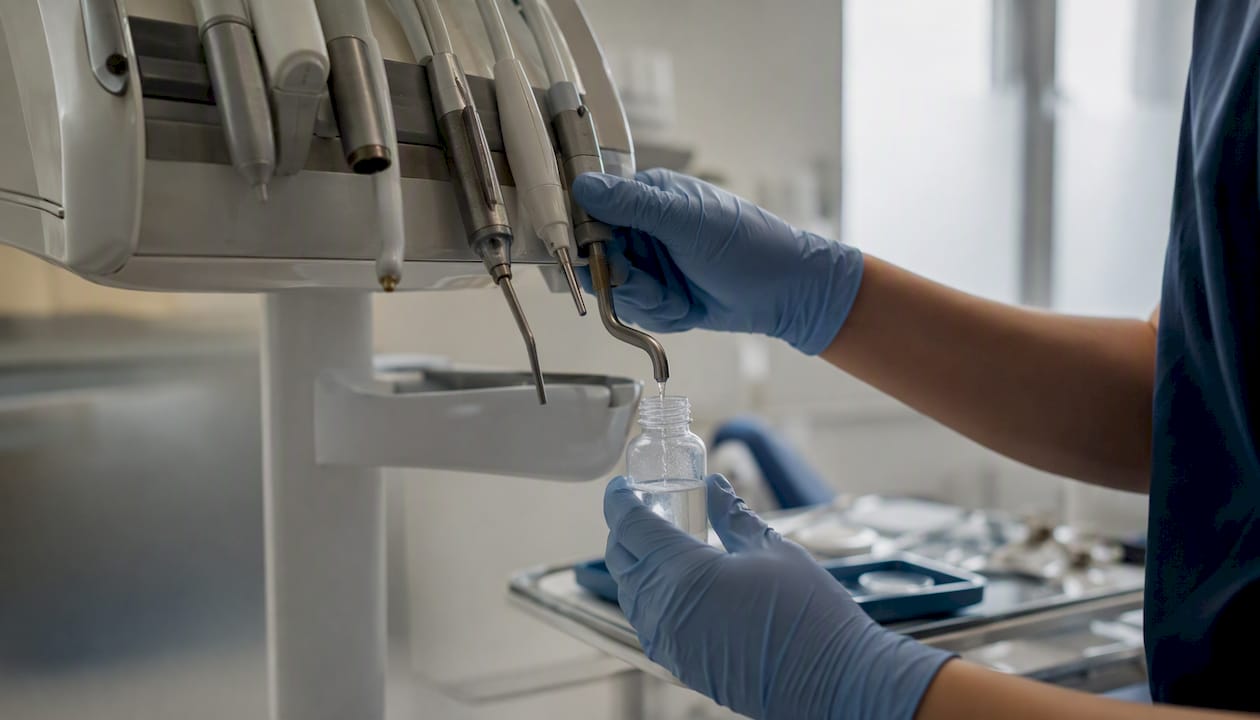
Take samples after the normal morning flush but before any shock treatment has been applied that day. Label each sample with the unit number, outlet type (handpiece, syringe, scaler), date, time, and the name of the person collecting it.
Frequency and action thresholds
Scenario | Recommended sampling frequency | Action level |
Routine monitoring (all units) | Quarterly (minimum) | >500 CFU/mL triggers immediate shock disinfection and retest |
After shock disinfection | 48 hours post-treatment | >500 CFU/mL: repeat shock, investigate root cause |
New unit installation | Before first clinical use | >500 CFU/mL: do not use until resolved |
Unit returning from extended closure (>72 hours) | Before resuming clinical use | >500 CFU/mL: shock disinfect and retest |
Surgical lines | Before each surgical list | Sterile irrigants required regardless of HPC result |
The CDC’s guidance is unambiguous: sterile water or saline must be used for surgical procedures involving bone or soft tissue, irrespective of routine monitoring results. No level of DUWL treatment makes mains-fed water acceptable for surgical irrigation.
What to do when results exceed the action level
Exceeding 500 CFU/mL is a signal to act, not to wait for the next scheduled sample. Withdraw the unit from clinical use, perform a shock disinfection following the SOP above, and retest. If a second result still exceeds the threshold, consider component replacement (tubing, reservoir, anti-retraction valves) and engage a specialist. Persistent failures after two consecutive shock treatments warrant a full water hygiene investigation to identify whether the source of contamination is the unit itself, the incoming supply, or a plumbing issue upstream.
What records do you need for CQC and HTM compliance?
A logbook that cannot be produced at inspection is as good as no logbook. CQC inspectors and HTM 01-05 audits expect to see a continuous, dated record of DUWL management activity. The minimum content is:
Daily flush times and the name of the responsible staff member
Reservoir preparation records: product name, batch number, concentration, date prepared, and expiry
Between-patient purge confirmation (can be a session-level tick rather than per-patient)
Shock disinfection records: date, product, concentration, contact time, operator name
Microbiological test reports: date sampled, unit and outlet, result in CFU/mL, laboratory name
Corrective actions taken when results exceeded the action level
Staff training records: who was trained, on what, and when
Equipment maintenance records: filter replacements, anti-retraction valve checks, hardware inspections
Example DUWL logbook template
Date | Task performed | Product/batch | Result/reading | Operator | Notes |
DD/MM/YYYY | Start-of-day flush (2 min) | N/A | Completed | Initials | |
DD/MM/YYYY | Reservoir refill | Product X | 10 ppm confirmed | Initials | Expiry: DD/MM/YYYY |
DD/MM/YYYY | Shock disinfection | Product Y | 60 min contact | Initials | Post-treatment sample sent |
DD/MM/YYYY | Microbiological result | Lab report ref | — | Initials | Within range |
Retain all records for a minimum of two years, or longer if your practice’s infection control policy specifies it. Digital records are acceptable provided they are backed up and can be printed for inspection. A bespoke logbook system designed for water hygiene compliance can simplify this considerably, particularly for practices managing multiple dental units.
Integrate DUWL records into your practice’s overarching infection control policy. The policy should reference the SOP, name the responsible person, and specify the review frequency. CQC expects to see the policy, the SOP, and the logbook as a coherent set, not three separate documents that do not reference each other.
When should you call a water hygiene specialist?
Most practices can manage routine DUWL maintenance in-house once a clear SOP is in place. There are situations, however, where specialist input is not optional.
Escalate to a specialist when:
HPC results exceed 500 CFU/mL after two consecutive shock treatments
Legionella is detected in any water sample from the premises
Visible biofilm is present in tubing, reservoirs, or at outlets
The dental unit has dead legs, unused branches, or plumbing that has not been flushed in more than 72 hours
The unit is more than ten years old and the manufacturer no longer provides IFU support
You are opening a new surgery or refurbishing an existing one
A healthcare water risk assessment has identified the dental unit water system as a high-risk area
Questions to ask a prospective water hygiene contractor:
Are your sampling methods UKAS-accredited and do they use neutralising agents in sample bottles?
What is your laboratory turnaround time for HPC and Legionella results?
Can you provide a written scheme of control and a site-specific risk assessment?
What remedial works do you carry out if results remain elevated after treatment?
How do you handle chemical waste disposal and trade effluent compliance?
Do you have experience working in CQC-regulated dental environments?
Expect a specialist to deliver a written risk assessment, a documented treatment report, post-treatment sample results, and a remedial works schedule if required. Downtime for a full system shock disinfection is typically a single clinical session; more complex remedial works involving plumbing modifications will require longer planning. HSG274 provides the framework for Legionella risk management that any competent contractor should be working within.
Key takeaways
Effective DUWL management requires daily flushing, continuous or scheduled chemical treatment, regular microbiological monitoring to confirm compliance with recommended limits, and sterile irrigants for every surgical procedure.
Point | Details |
Daily flushing is non-negotiable | Flush for two minutes at session start and 20–30 seconds between every patient to prevent biofilm accumulation. |
Chemical treatment needs monitoring | Continuous dosing or scheduled shock disinfection must be validated by quarterly microbiological sampling at ≤500 CFU/mL. |
Sterile irrigants for surgery | Mains-fed DUWL water is never acceptable for surgical procedures, regardless of routine monitoring results. |
Recordkeeping is your audit defence | Logbooks covering flushes, chemical batches, shock treatments, and test results must be available for CQC inspection at any time. |
Bespokecompliancesolutions provides specialist support | For persistent HPC failures, Legionella detection, or full compliance programmes, Bespokecompliancesolutions delivers risk assessments, water sampling, system disinfection, and bespoke logbook implementation across UK dental premises. |
The gap between what practices think they are doing and what the records show
The most common problem in dental DUWL management is not ignorance of the protocol. Most dental teams know they should flush, treat, and test. The problem is the gap between what is being done and what is being documented, and between what the product label says and what is actually being applied.
Practices that have never had a failed microbiological result often assume their system is clean. Sometimes it is. More often, they have never tested it. A quarterly sampling programme is not a bureaucratic formality; it is the only way to know whether your chemical treatment is working, because biofilm does not announce itself. You cannot see it, smell it, or taste it in the water.
The second pitfall is chemical concentration. Continuous dosing products require a specific concentration to be effective. Too low and you are providing biofilm with a mildly hostile but ultimately survivable environment, which can select for more resistant strains over time. Too high and you risk material damage to the unit. Test strips exist for a reason; use them at the start of every session.
The third, and perhaps most consequential, error is the assumption that shock disinfection alone is a long-term solution. It is not. A shock treatment resets the system; continuous treatment maintains it. Practices that shock quarterly but do nothing in between are leaving a three-month window for biofilm to re-establish. The two strategies are complementary, not interchangeable.
One more thing worth saying plainly: the IFU is not a suggestion. If your dental unit manufacturer specifies a particular product chemistry or concentration, using something different because it is cheaper or more convenient is a compliance risk and potentially a warranty issue. The FDA’s position on validated reprocessing instructions is clear, and it applies to UK practice through the alignment of HTM 01-05 with manufacturer guidance.
How Bespokecompliancesolutions supports dental DUWL compliance
Dental practices that want a complete, inspection-ready DUWL compliance programme, without building it from scratch, get exactly that from Bespokecompliancesolutions. Rather than working through generic templates, the team starts with a site-specific Legionella risk assessment covering your dental unit water system and the wider building, identifies control gaps, and produces a written scheme of control you can hand to a CQC inspector with confidence.
From there, Bespokecompliancesolutions provides UKAS-aligned water sampling and microbiological analysis, system disinfection services, and a bespoke logbook implementation that matches your practice’s specific units and maintenance schedule. Training for your clinical and support staff is included where needed, so the people responsible for daily flushing and reservoir management understand exactly what they are doing and why. For practices managing multiple surgeries or sites, the team scales the programme accordingly.
To discuss a compliance package for your dental practice, contact Bespokecompliancesolutions directly or visit the Legionella compliance for healthcare premises page to see how the service is structured and request a quote.
Useful sources and further reading
The documents below are the primary references for DUWL management in UK dental practice. Keep printed or saved copies in your audit folder alongside your SOP and logbook.
Source | Why it matters |
CDC: Best practices for dental unit water quality | Sets the ≤500 CFU/mL benchmark and sterile irrigant requirement; core authority for monitoring protocols |
FDA: Dental unit waterlines | Confirms waterlines cannot be sterilised; supports IFU alignment and validated reprocessing expectations |
ADA: Dental unit waterlines | Practical flushing timings (20–30 seconds), anti-retraction guidance, and monitoring programme recommendations |
OSAP white paper: dental unit water quality | SOP templates, sampling methods, and ISO 16954:2015 test method recommendation for biofilm treatment validation |
gov.uk: Decontamination in primary care dental practices | UK duty-holder requirements, documented SOP obligations, and HTM 01-05 alignment |
HSE HSG274: Legionella and other waterborne pathogens | Legionella risk assessment framework applicable to dental premises; escalation criteria and written scheme of control |
Plumbing design, dead-leg avoidance, and storage guidance to reduce biofilm risk at source |
Save these URLs to your practice intranet or compliance folder. When updating your infection control policy or preparing for a CQC inspection, cross-reference each section of your SOP against the relevant document to demonstrate that your protocols are grounded in current authoritative guidance.
Recommended
Comments