
How to identify high risk water outlets in buildings
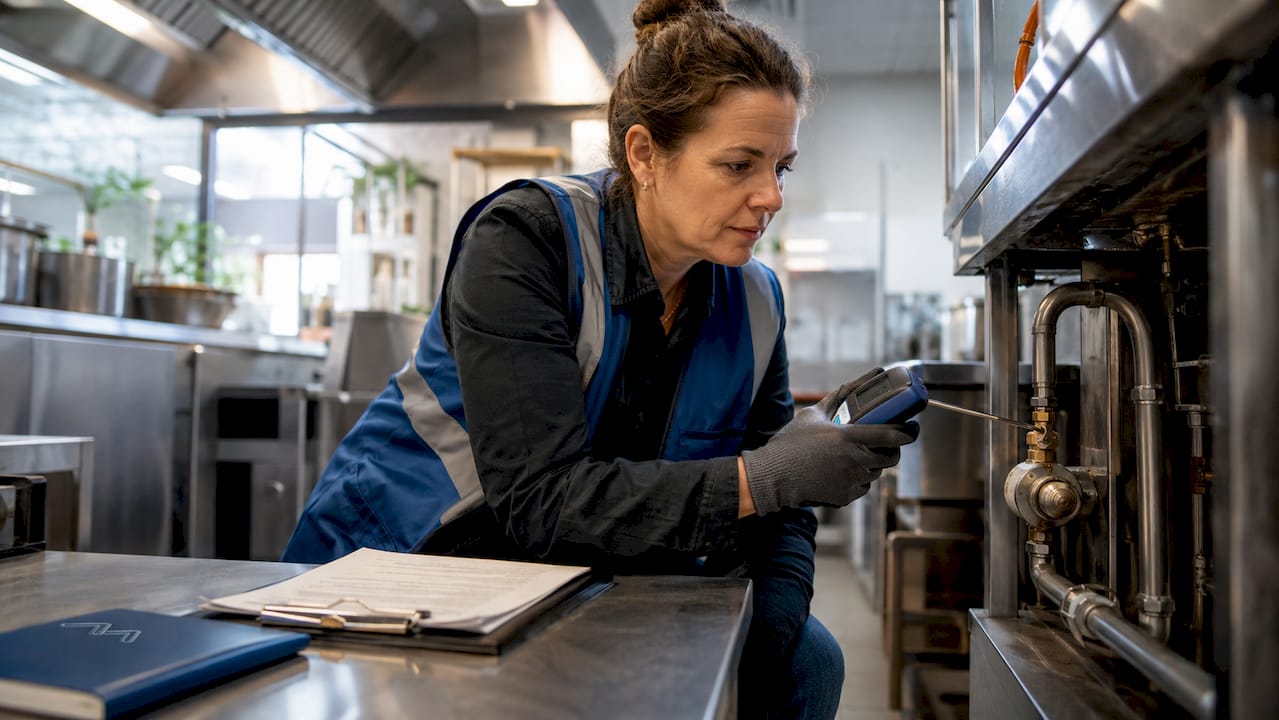
High-risk water outlets in buildings are defined as any point in a water system where conditions favour Legionella bacteria growth, specifically where water temperatures fall within the 20°C–45°C growth range, where water stagnates, or where aerosols are generated. Under HSE ACOP L8 and HSG274, facility managers in commercial and healthcare buildings carry a legal duty to identify these outlets and manage them as part of a documented water safety programme. Failing to do so is not a compliance oversight. It is a direct risk to human health. This guide covers the criteria, inspection methods, and common errors that determine whether your water safety programme holds up to scrutiny.
Which water outlets pose the highest Legionella risk in buildings?
The outlets that carry the greatest risk share three characteristics: they generate aerosols, they operate within the Legionella growth zone of 20°C–45°C, or they allow water to sit undisturbed. Understanding which fixtures meet one or more of these criteria is the starting point for any high risk plumbing evaluation.
The following outlet types and system features consistently appear in Legionella incidents across commercial and healthcare buildings:
Showers and flexible shower hoses. Showers are the single highest-risk outlet due to aerosol production, warm water within the growth range, and internal biofilm accumulation. Shower hoses and heads require regular descaling, cleaning, and periodic replacement.
Infrequently used outlets. Any tap, shower, or drinking fountain used less than once a week becomes a stagnation point. Water sitting in the pipework warms to ambient temperature and creates ideal conditions for bacterial growth.
Dead legs in pipework. A dead leg is a section of pipe that branches off the main circuit but carries no flow. Dead legs form stagnant water areas and are among the most common overlooked risks in older commercial and healthcare buildings.
Thermostatic Mixing Valves (TMVs). TMVs blend hot and cold water to deliver a safe outlet temperature, typically around 41°C–43°C in healthcare settings. That blended temperature sits squarely in the Legionella growth zone, making TMV maintenance a non-negotiable compliance task.
Cold water storage tanks. Any tank where water warms above 20°C, accumulates sediment, or lacks a tight-fitting lid becomes a risk source for the entire downstream system.
Hot water cylinders. Cylinders that fail to maintain storage temperatures at or above 60°C create conditions for Legionella colonisation throughout the hot water circuit.
Specialist equipment. Cooling towers, spa pools, and emergency eyewash stations all present elevated risk. Emergency eyewash stations are particularly overlooked because they are rarely activated, meaning water stagnates in the supply line for weeks or months at a time.
How to evaluate outlet usage and maintenance history
Usage frequency is the most underused diagnostic tool when facility managers assess water outlet safety. An outlet used daily is self-flushing. An outlet used once a fortnight is a liability.
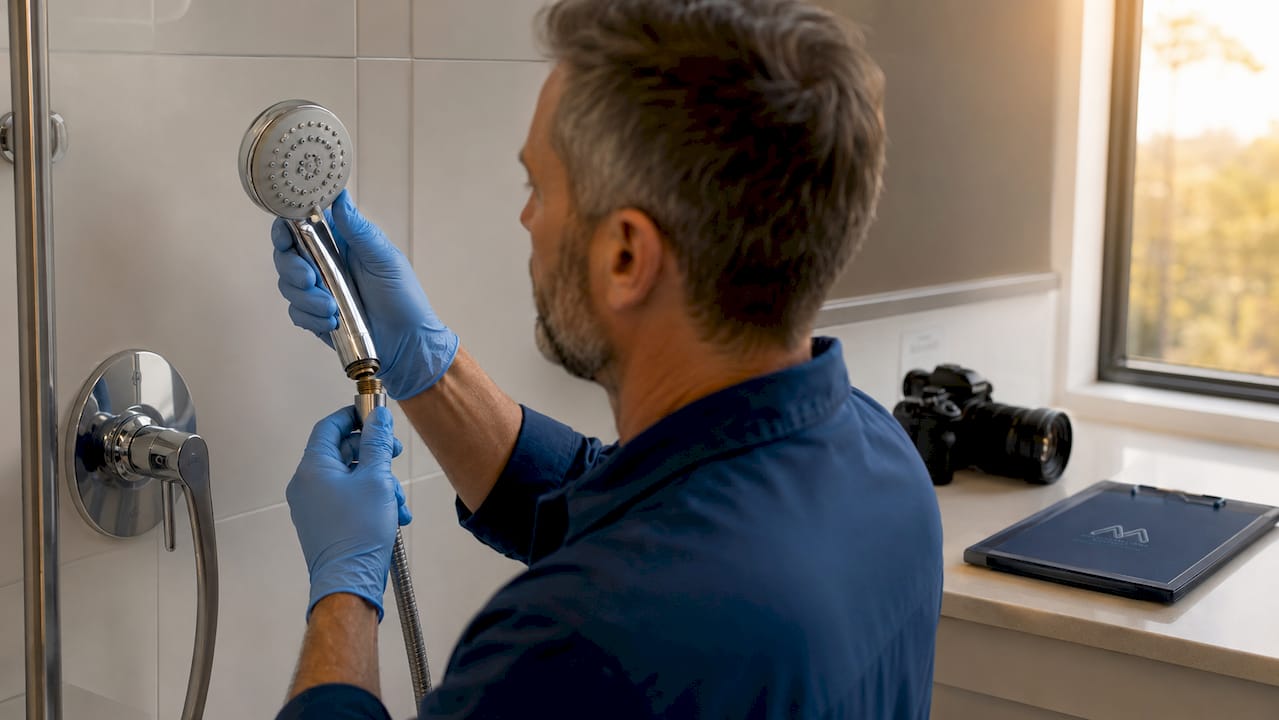
The standard protocol is clear: outlets unused for 7 or more days must be flushed for a minimum of 2 minutes before use. That 2-minute flush is not a precaution. It is the minimum required to clear stagnant water from the supply line and restore temperatures to acceptable levels. Documenting every flush, with the date, time, and outlet reference, is what separates a defensible compliance record from a paper exercise.
Condition checks are equally important. When inspecting outlets, look for:
Limescale build-up on showerheads and tap aerators. Scale traps biofilm and reduces the effectiveness of thermal disinfection.
Visible biofilm or slime inside flexible hoses or on internal surfaces. Biofilm is a protective matrix that shields Legionella from both heat and chemical treatment.
Inconsistent temperature readings at the outlet. A tap that delivers hot water at 42°C when it should reach 50°C within one minute indicates a system fault that needs investigation.
Missing or incomplete flushing logs. Gaps in records are a compliance failure in their own right, regardless of what the physical outlet condition looks like.
Pro Tip: Photograph the condition of showerheads, hose connections, and tap aerators during every inspection. A dated photograph is stronger evidence of due diligence than a written note alone.
What temperature criteria help identify and manage high-risk outlets?
Temperature is the most objective measure available when recognising hazardous water systems. The thresholds set out under HSG274 are not targets. They are minimum standards.
Parameter | Required standard | Risk if not met |
Hot water storage | ≥60°C | Legionella survives and multiplies |
Hot water at outlet | ≥50°C within 1 minute | Growth zone conditions at point of use |
Cold water at outlet | <20°C after running to waste | Warm cold water supports bacterial growth |
TMV blended output | Typically 41°C–43°C (healthcare) | Sits within the 20°C–45°C growth zone |
Hot water systems must store water at or above 60°C and deliver at least 50°C to outlets within one minute. Cold water must remain below 20°C after running to waste. These two thresholds define whether a system is operating safely or not.
Sentinel outlets are the practical tool for monitoring these thresholds across a large building. A sentinel outlet is the first and last outlet on a hot or cold water circuit. Checking temperatures at sentinel points gives you a representative picture of the whole circuit without testing every single tap. If a sentinel outlet fails its temperature check, every outlet on that circuit is potentially at risk.
TMVs present a specific monitoring challenge. The hot supply to a TMV must be maintained above 50°C to prevent Legionella growth on the hot side. Yet the blended output sits in the growth zone by design. TMVs can incubate Legionella in the blended water output if the hot supply temperature drops or if the valve is not serviced regularly. Monthly temperature checks at TMV outlets, combined with annual strip-down servicing, are the standard control measures under HSG274.
Pro Tip: Use a calibrated digital thermometer with a probe designed for outlet testing. Infrared surface thermometers are not accurate enough for compliance temperature checks at water outlets.
Automated temperature monitoring systems can log outlet temperatures continuously and flag exceedances in real time. For large healthcare sites or multi-storey commercial buildings, automated temperature monitoring removes the reliance on manual checks and creates an auditable data trail without additional staff time.
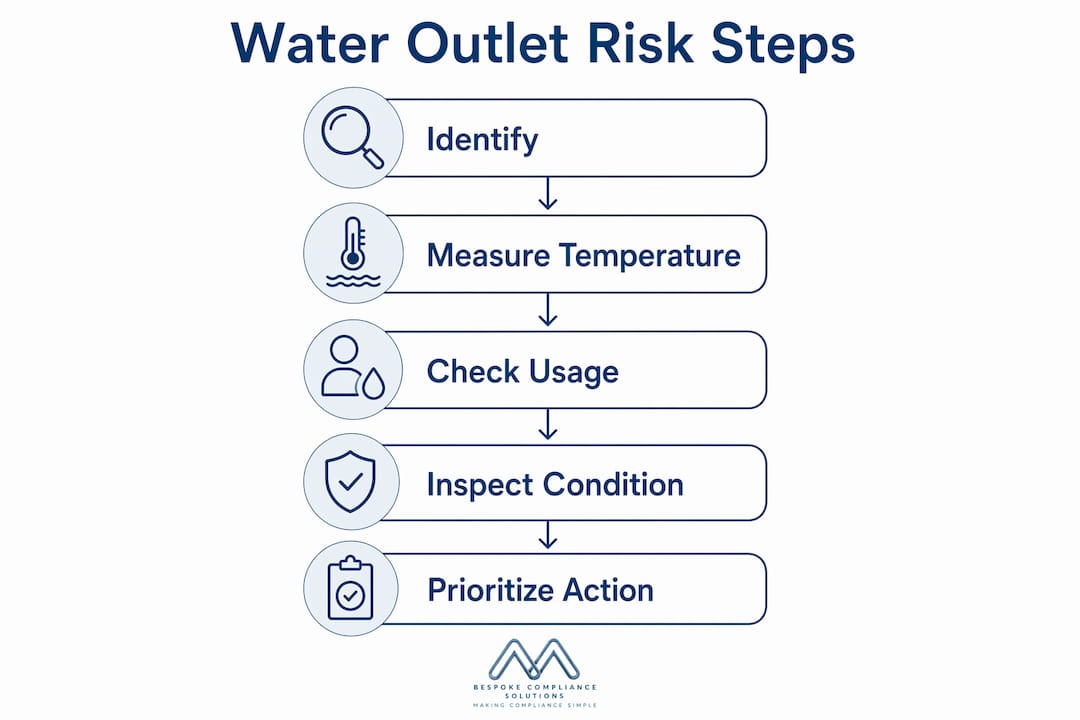
What practical steps are needed to spot risky water outlets during a site inspection?
A systematic water outlet safety inspection requires preparation before you set foot in the plant room. Arriving without a current system schematic means you cannot identify dead legs, capped pipes, or unmapped outlets. The schematic is not a formality. It is the map that makes the inspection meaningful.
The inspection process covers two parallel tracks: physical condition and documentation.
Physical inspection checklist:
Confirm all outlets on the schematic are physically present and accessible
Check for capped pipes or blanked-off connections that leave residual branches attached to the live supply. Capped pipework leaving a branch connected creates a dead leg that fosters biofilm and must be removed back to the main tee
Record outlet temperatures using a calibrated probe and compare against HSG274 thresholds
Inspect showerheads, hoses, and tap aerators for scale, corrosion, and biofilm
Note any outlets in areas with low occupancy, seasonal use, or recent refurbishment
Documentation review checklist:
Flushing logs: are all infrequently used outlets recorded with dates and durations?
Temperature monitoring records: are sentinel outlet checks current and within acceptable ranges?
TMV service records: have all TMVs been serviced within the last 12 months?
Previous risk assessment: does it reflect the current system layout, or has the building been altered since it was written?
Prioritising outlets after the inspection is as important as the inspection itself. Outlets that fail temperature checks, show physical contamination, or lack flushing records move to the top of the remediation list. Outlets in healthcare settings, particularly those serving immunocompromised patients, require the highest priority regardless of their apparent condition.
For commercial premises compliance, the same principles apply, though the risk profile differs. Office buildings with large numbers of infrequently used toilets and kitchenettes on upper floors are a common source of undetected stagnation risk.
Common mistakes when identifying high-risk water outlets
The most costly errors in water outlet risk identification are not technical. They are procedural.
Treating capped pipes as safe. A capped pipe is not a closed system. Removing pipework back to the main tee is the only true mitigation for a dead leg. Leaving a capped branch in place and recording it as “managed” is a compliance fiction.
Ignoring emergency fixtures. Emergency eyewash stations and safety showers are tested infrequently. The supply lines stagnate between tests. They must appear on the flushing schedule with the same rigour as any other outlet.
Relying on generic templates. Generic risk assessment templates without site-specific asset evidence lead to non-compliance. A template that lists “showers” as high risk without identifying which showers, where they are, and when they were last checked is not a risk assessment. It is a liability.
Misunderstanding TMV risk. Many facility managers assume that because a TMV delivers water at a safe user temperature, the system behind it is also safe. The opposite is true. The blended output temperature is the risk, not the protection.
Incomplete flushing records. A flushing programme without logs is indistinguishable from no flushing programme at all. Records must include the outlet reference, date, duration, and the name of the person who carried out the flush.
Pro Tip: Humidity and condensation in plant rooms and ceiling voids can affect ambient water temperatures in nearby pipework. When assessing office humidity risks alongside water system design, you often find temperature anomalies that a standalone water inspection would miss.
Key takeaways
Identifying high-risk water outlets requires assessing temperature control, usage frequency, and system design against HSE ACOP L8 and HSG274 standards, with site-specific records to demonstrate compliance.
Point | Details |
Temperature thresholds are non-negotiable | Hot storage must reach ≥60°C; outlets must deliver ≥50°C within one minute. |
Stagnation is the primary risk driver | Outlets unused for 7+ days must be flushed for at least 2 minutes before use. |
TMVs require active monitoring | TMV blended output sits in the Legionella growth zone and demands monthly checks and annual servicing. |
Dead legs must be physically removed | Capping a pipe does not eliminate the dead leg risk; removal back to the main tee is the only reliable fix. |
Generic templates create compliance gaps | Site-specific schematics and live flushing logs are what make a risk assessment defensible. |
What I’ve learned from years of water outlet inspections
The thing that surprises facility managers most is how often the highest-risk outlets are the ones nobody thinks about. Not the showers in the main changing rooms. The shower in the disused gym on the third floor that has been locked since a refurbishment two years ago. The emergency eyewash station in the laboratory that gets tested once a year and forgotten the other 364 days. These are the outlets that appear in incident reports.
The second thing I have noticed is that documentation quality is a better predictor of compliance than physical condition. A building with spotless pipework and no flushing logs is in a worse position than a building with older infrastructure and meticulous records. Regulators and insurers both understand this. A defensible risk assessment is dynamic, linked to live logs, and updated when the building changes. A static document filed away after the initial survey is not a control measure.
Mixed-use buildings and older healthcare estates present the hardest challenges. Layouts change, outlets get decommissioned informally, and schematics fall out of date. The gap between what the drawing shows and what is actually in the ceiling void is where Legionella risk hides. Photographic evidence and updated schematics are not optional extras. They are the foundation of a programme that will hold up when it is tested.
Collaboration between facility managers and specialist contractors matters more than most people acknowledge. The facility manager knows the building. The contractor knows the biology and the regulatory framework. Neither one alone produces a complete picture.
— Sammi
How Bespokecompliancesolutions supports your water safety programme
Bespokecompliancesolutions works with facility managers across commercial and healthcare sectors to identify and manage high-risk water outlets with site-specific evidence, not generic templates.
Every assessment Bespokecompliancesolutions carries out is built around your building’s actual layout, usage patterns, and system condition. Services include bespoke Legionella risk assessments, water system flushing and disinfection, TMV servicing, and temperature monitoring programmes designed to meet HSE ACOP L8 and HSG274 requirements. For commercial premises, the Legionella compliance service covers everything from initial risk identification through to ongoing logbook management. Contact Bespokecompliancesolutions to arrange a site-specific consultation and find out exactly where your water system stands.
FAQ
What makes a water outlet high risk for Legionella?
A water outlet is high risk when it generates aerosols, operates within the 20°C–45°C Legionella growth zone, or allows water to stagnate. Showers, TMV-fed outlets, and infrequently used fixtures are the most common examples.
How often should infrequently used outlets be flushed?
Any outlet unused for 7 or more days must be flushed for at least 2 minutes before use. The flush date, duration, and outlet reference must be recorded in the flushing log.
What temperature should hot water reach at the outlet?
Hot water must reach at least 50°C at the outlet within one minute of running, with storage temperatures maintained at or above 60°C. Cold water must remain below 20°C after running to waste.
Are TMVs a Legionella risk?
Yes. TMVs blend hot and cold water to produce output temperatures within the Legionella growth zone. The hot supply must stay above 50°C, and TMVs require monthly temperature checks and annual servicing to remain safe.
What is a dead leg in a water system?
A dead leg is a section of pipework that branches off the main circuit but carries no active flow. Water stagnates in dead legs, creating ideal conditions for Legionella growth. The only reliable fix is physical removal back to the main tee.
Recommended
Comments