
What is a safety management system for water?

A water safety management system is a structured, proactive framework that identifies, assesses, and controls hazards across the entire water supply chain to protect public health and meet regulatory requirements. The recognised industry term for this approach is a Water Safety Plan (WSP), a model endorsed by the World Health Organisation and adopted by regulators worldwide. For managers responsible for water quality and compliance, understanding how safety systems in water work is not optional. It is the foundation of every defensible compliance programme.
The WSP model covers the full supply chain, from source water through treatment, distribution, and point of use. It classifies hazards as chemical, microbiological, or physical, then scores each one using a risk matrix. Water Safety Plans apply a likelihood multiplied by severity calculation, with low risk scoring 0–5 and medium risk scoring 6–9. That scoring system tells you where to direct resources first, before an incident forces your hand.
What is a safety management system for water risk assessment?
Risk identification is the engine of any WSP. The process begins by dividing the water supply system into discrete sections, for example, storage tanks, distribution pipework, and point-of-use outlets, and analysing each section for potential hazards.

Hazard categories and risk scoring
Three hazard categories cover the full range of threats in a water system.
Microbiological hazards: Legionella pneumophila, Pseudomonas aeruginosa, and other waterborne pathogens that proliferate in stagnant or warm water.
Chemical hazards: Disinfection by-products, heavy metals from ageing pipework, and excess chlorine or chloramine residuals.
Physical hazards: Sediment, biofilm, and cross-connection contamination from backflow events.
Each identified hazard receives a risk score calculated as likelihood multiplied by severity. A hazard with a likelihood score of 3 and a severity score of 4 produces a risk score of 12, placing it in the medium band. A score of 2 multiplied by 2 produces 4, placing it in the low band. The risk matrix methodology gives managers a defensible, auditable basis for prioritising controls rather than relying on intuition.
Priority setting in practice
The table below illustrates how risk scores translate into control priority.
Risk score | Band | Control priority |
0–5 | Low | Schedule for routine review |
6–9 | Medium | Implement controls within defined timeframe |
10+ | High | Immediate corrective action required |
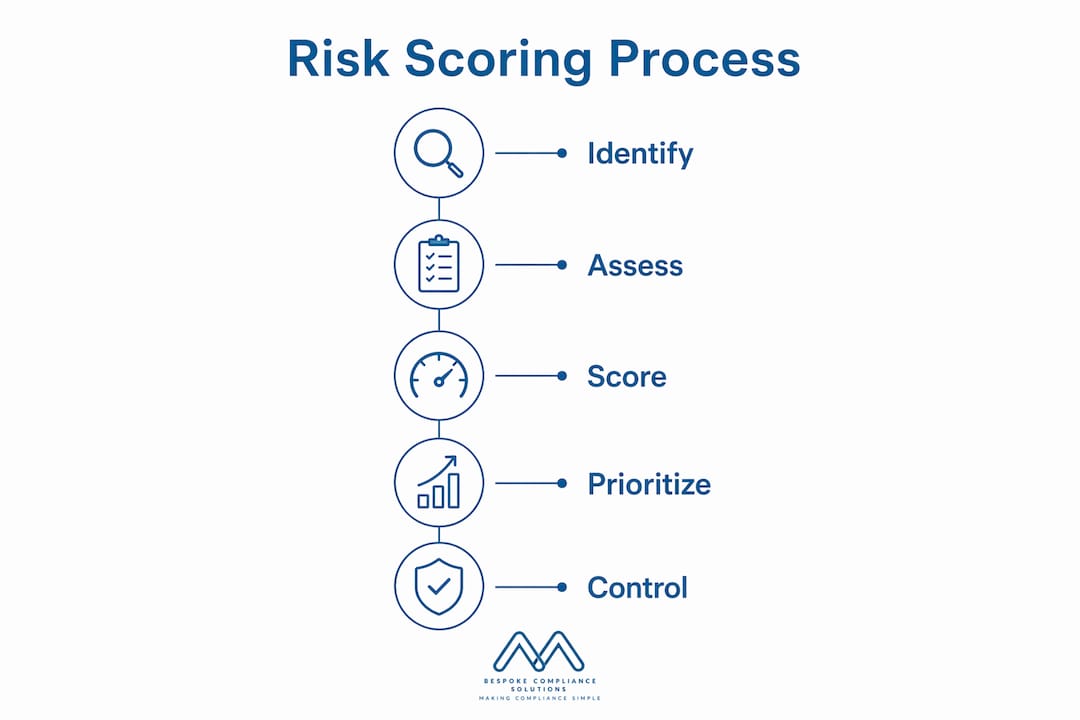
Medium and high-band hazards require documented control measures, assigned owners, and defined timescales. Low-band hazards still appear in the risk register but do not demand the same urgency. This tiered approach is what separates a water hazard identification programme from a simple checklist.
How does the Plan-Do-Check-Act cycle support water safety management?
The Plan-Do-Check-Act (PDCA) cycle is the operating model that keeps a WSP alive. PDCA phases support identification, implementation, monitoring, and review of controls in a continuous loop. Without this cycle, a safety plan becomes a document filed and forgotten.
Each phase has a specific function in water safety management.
Plan: Define the system boundary, identify hazards, score risks, and select control measures. Assign responsibility for each control to a named individual.
Do: Implement the controls. This includes physical measures such as temperature management, disinfection dosing, and dead-leg removal, as well as procedural controls like flushing regimes and inspection schedules.
Check: Monitor controls against defined performance targets. Record results in a logbook. Investigate any deviation from expected performance immediately.
Act: Review monitoring data, update risk assessments when the system changes, and revise controls in response to new hazards or incidents.
The PDCA cycle also applies to physical safety controls beyond water quality. Pool fencing reduces drowning risk by up to 50%, which illustrates how a physical control measure, planned and implemented correctly, delivers measurable risk reduction. The same logic applies to temperature controls, dosing systems, and access restrictions in building water systems.
System adaptability is a defining feature of effective water safety management. Effective WSPs are living management processes integral to daily operations, not static documents produced for audit purposes. When a building undergoes refurbishment, when occupancy patterns change, or when a new water source is introduced, the WSP must be updated before the change takes effect.
Pro Tip: Set a calendar trigger to review your WSP whenever a significant change occurs to the water system, not just at the annual review date. Changes to pipework, occupancy, or water source all alter the risk profile.
What international standards and guidelines underpin water safety management systems?
The WHO Water Safety Plan framework is the global reference point for water safety management in supply systems. It defines the risk-based approach, the system description requirements, and the monitoring and verification obligations that national regulators translate into law.
ISO 21195:2020 addresses technical monitoring standards in specific water safety contexts. ISO 21195:2020 sets a 95% required detection performance for man-overboard detection systems, demonstrating how international standards codify minimum performance thresholds for safety-critical monitoring. The principle transfers directly to water quality monitoring: define the performance threshold, measure against it, and act when it is not met.
The contrast between proactive and reactive safety methods is a recurring theme in water safety guidelines. Hardware safety systems like SVRS devices activate only after a blockage occurs. They are reactive by design and cannot substitute for proactive hydraulic design and active supervision. The same distinction applies in building water systems: a temperature alarm that fires after Legionella conditions have developed is not a substitute for a control programme that prevents those conditions from arising.
Water safety plans must integrate cross-cutting priorities such as climate resilience and equity, not just compliance. For UK managers, this means considering how climate-driven changes to water temperature or supply reliability affect the risk profile of your system. Regulatory compliance sets the floor. Effective water safety management aims higher.
What are the common challenges in implementing water safety management systems?
The most damaging mistake organisations make is treating a WSP as a paperwork exercise. A safety plan that sits in a folder and is reviewed only when an auditor visits provides no protection. Water suppliers must continuously review supply operation controls as part of daily operations. That requires management commitment, not just a compliance officer.
Practical challenges that managers encounter include:
Undefined critical control limits: Without a specific threshold, such as a hot water return temperature below 50°C, staff cannot know when to act. Every critical control point needs a defined limit and a pre-authorised corrective action.
Delayed response to breaches: Managers must respond immediately when monitoring thresholds are breached. Waiting for external laboratory results before acting is not acceptable when consumer health is at risk.
Unclear staff roles: If nobody owns a control measure, it will not be monitored consistently. Every task in the WSP needs a named responsible person and a deputy.
Failure to integrate with existing risk management: A WSP that operates in isolation from the organisation’s broader health and safety programme creates gaps. Water risk responsibilities must sit clearly within the management structure.
Inadequate training: Staff who do not understand why a control matters will not apply it reliably. Legionella awareness training is a regulatory expectation under HSE L8, not an optional extra.
Pro Tip: Define corrective actions before you need them. Pre-authorise your facilities manager to isolate a water system or increase chlorine dosing without waiting for sign-off from senior management. Speed of response is what protects people.
The water hygiene risk register is the practical tool that makes all of this visible. It records every identified hazard, its risk score, the assigned control, the monitoring frequency, and the corrective action. Without a maintained register, you cannot demonstrate that your system is working.
Key takeaways
A water safety management system works because it combines structured risk assessment, defined control measures, and continuous monitoring within a single, living management process.
Point | Details |
Risk scoring drives priorities | Use likelihood × severity to score hazards and allocate controls to high and medium risks first. |
PDCA keeps the system current | Review and update your WSP whenever the water system, occupancy, or supply conditions change. |
Critical control limits need pre-authorised actions | Define thresholds and authorise immediate responses before a breach occurs, not after. |
Staff roles must be named | Every control measure requires a named owner; unassigned tasks are not completed consistently. |
Static documents provide no protection | A WSP only works if it is integrated into daily operations and treated as a live management tool. |
Water safety management: why culture matters more than documentation
From my experience working with organisations across the UK, the gap between a compliant water safety system and an effective one is almost always cultural, not technical. Managers who treat their WSP as a living tool, who brief their teams on why controls matter and what to do when something goes wrong, consistently outperform those who rely on documentation alone.
The organisations that concern me most are those that have invested in the right paperwork but have never tested whether their staff can actually execute a corrective action under pressure. A pre-authorised response plan is only useful if the person on site knows it exists and knows what it says. I have seen well-documented systems fail at precisely this point.
Technology is changing the picture. Automated temperature monitoring removes the human error from routine data collection and flags deviations in real time. That is a genuine improvement. But technology does not replace the judgement of a trained, engaged facilities team. It supplements it.
The importance of water safety systems is not just about avoiding enforcement action. It is about protecting the people who use your building every day. That framing changes how managers engage with the process. Compliance becomes a by-product of doing the right thing, not the goal in itself.
— Sammi
How Bespokecompliancesolutions supports your water safety programme
Bespokecompliancesolutions works with commercial, healthcare, housing, and facilities management organisations across the UK to build water safety management systems that function in practice, not just on paper.
From bespoke Legionella risk assessments to water tank cleaning and disinfection, every service is tailored to your site’s specific risk profile. Bespokecompliancesolutions also provides logbook implementation, TMV servicing, water sampling, and ongoing consultancy to keep your controls current as your building and its occupancy evolve. If your WSP needs a structured review or you are building one from scratch, the team at Bespokecompliancesolutions can assess your system and define a control programme that meets HSE L8 and current UK regulatory requirements.
FAQ
What is a Water Safety Plan?
A Water Safety Plan is the recognised industry framework for managing water safety. It identifies hazards across the supply chain, scores risks using a likelihood and severity matrix, and defines controls and monitoring requirements.
How does a risk matrix work in water safety management?
A risk matrix scores each hazard by multiplying its likelihood by its severity. Scores of 0–5 indicate low risk, 6–9 indicate medium risk, and scores of 10 or above require immediate corrective action.
What regulations govern water safety management in the UK?
HSE Approved Code of Practice L8 and the associated Technical Guidance HSG274 set the legal framework for Legionella control and water hygiene management in UK premises. The WHO Water Safety Plan model underpins the risk-based approach required by these regulations.
How often should a water safety management system be reviewed?
A WSP must be reviewed at least annually and whenever a significant change occurs to the water system, building occupancy, or supply conditions. Treating it as a living document is a regulatory expectation, not best practice.
What is the difference between a proactive and reactive water safety approach?
A proactive approach uses risk assessment, defined controls, and continuous monitoring to prevent hazardous conditions from developing. A reactive approach responds only after a problem has occurred, which increases the risk of harm to building occupants.
Recommended
Comments