
What is a water hygiene risk matrix?

Managing water hygiene risk without a structured scoring tool is like trying to rank hazards by instinct alone. You might get it right occasionally, but you will miss things that matter. A water hygiene risk matrix, formally recognised within water safety planning as a risk index tool, gives facilities managers and compliance officers a reproducible, evidence-based method for ranking water system hazards by their likelihood and potential consequences. This article explains what the matrix is, how it is constructed, where it fits within compliance frameworks, and the practical pitfalls you need to avoid when building or reviewing one.
Table of Contents
Key takeaways
Point | Details |
Matrix definition | A water hygiene risk matrix combines likelihood and consequence scores to create a prioritised risk index for water system hazards. |
Scoring methodology | Scores are multiplied to produce risk levels, typically classified as low, medium, or high, to guide mitigation decisions. |
Compliance integration | The matrix sits within a broader water safety plan, linking hazard identification to documented controls and audit evidence. |
Common pitfall | Confusing a high risk score with poor control effectiveness is a frequent operational error that undermines compliance. |
Review and evidence | Scores must be supported by documented rationale and reviewed regularly to remain accurate and defensible. |
What is a water hygiene risk matrix?
A water hygiene risk matrix is a structured scoring tool used within water safety planning to rank identified hazards according to two variables: the likelihood that a hazard event will occur, and the severity of its consequences if it does. The product of these two scores generates a risk index that places each hazard into a priority band, typically labelled low, medium, or high. That banding then drives decisions about which controls to implement first and how urgently.
The matrix does not replace professional judgement. It provides a consistent framework so that judgement is applied systematically and can be documented, audited, and defended. This matters significantly in regulated environments where a Legionella risk assessment must demonstrate a logical, reproducible approach to hazard prioritisation.
How likelihood and consequence are scored
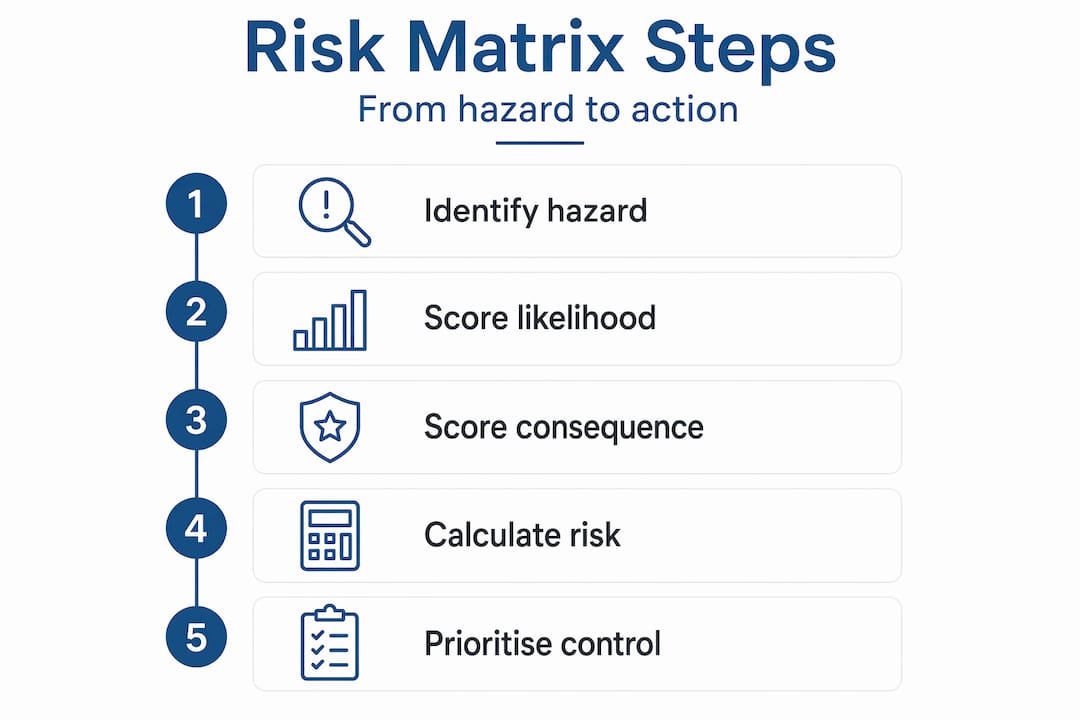
Five-level descriptors for both likelihood and consequence are standard across most water safety planning frameworks. A typical likelihood scale runs from “rare” (score 1) through to “almost certain” (score 5), while consequence scales move from “negligible health impact” through to “severe illness or fatality.” Each hazard receives a score on both scales, and those scores are multiplied together.
The resulting risk scores are then banded. For example:
Scores 1 to 4: Low risk. Monitor and maintain existing controls.
Scores 5 to 12: Medium risk. Review controls and implement targeted improvements within a defined timeframe.
Scores 15 to 25: High risk. Immediate action required; do not defer.
Those bands are not universal. The thresholds your organisation sets must reflect its risk appetite and the regulatory context in which it operates, particularly in healthcare or housing association settings where vulnerable populations may be present.
The matrix within your water safety plan
Understanding the matrix in isolation is not enough. It is one component of a larger process. IWA guidance is explicit that risk matrices should be embedded within documented water safety plans rather than used as standalone spreadsheets. The sequence matters.
Map the system. Divide your water infrastructure into logical sections: storage, distribution, treatment, and point-of-use outlets. Each section creates a defined scope for hazard identification.
Identify hazards. For each system section, list the credible hazards. This includes biological threats such as Legionella, chemical contamination, and physical failures such as dead legs or inadequate temperatures.
Apply the matrix. Score each hazard for likelihood and consequence within its specific system context. A dead leg in a little-used shower presents a different risk profile from the same configuration in a main distribution header.
Assign control measures. Matrix outputs guide which controls are prioritised. High-scoring hazards trigger immediate corrective action; medium-scoring hazards feed into a planned maintenance or monitoring schedule.
Document and link to monitoring. Every score must connect to an operational control and a monitoring frequency. A matrix score is a hypothesis; ongoing monitoring tests whether that hypothesis holds true in real conditions.
Review periodically. The matrix is a living document. Changes to the system, occupancy, or usage patterns require a formal review and rescoring.
When assessing waterborne pathogen risk, the matrix becomes particularly valuable for Legionella control because it forces a structured consideration of both conditions that support bacterial growth and the health impact on those exposed. That dual consideration is at the heart of responsible water hygiene assessment.
Pitfalls and nuances that undermine accuracy
Most matrix errors are not mathematical. They are interpretive. Variability in how likelihood and consequence are defined across different practitioners, organisations, and jurisdictions is one of the most consistent problems in water safety planning. If two assessors apply the same scale to the same hazard and reach different scores, the matrix is not functioning as intended.
“Risk matrices are useful in data-sparse contexts but must be built carefully to avoid misprioritisation caused by inconsistent scoring boundaries.”
Several other nuances deserve your attention:
Risk score versus control effectiveness. A score of 15 tells you the hazard is high priority before controls are considered. It does not tell you whether your existing controls are working. Matrix results prioritise risks but require separate operational monitoring to verify control success. Conflating these two things leads to false assurance.

Avoiding model drift. Scores assigned during an initial assessment tend to remain unchanged unless there is a deliberate review process. Without documented evidence and rationale tied to each score, the matrix gradually loses touch with the actual state of the system. This is called model drift, and it is more common than most compliance teams realise.
Advanced likelihood scoring. A significant improvement on basic likelihood scales is separating likelihood into sub-components: past event frequency and current system barrier effectiveness. Scoring these separately and combining them reduces the subjective bias that comes from a single, catch-all likelihood judgement. It grounds the assessment in both historical data and the current condition of your system.
Pro Tip: Set clear written boundary criteria for each score level before you begin scoring. If your team cannot agree on what “likely” means in practice, your matrix will produce unreliable results from the outset.
Building and maintaining your matrix in practice
The quality of a water hygiene risk matrix depends almost entirely on the groundwork done before any scores are assigned. Here is a practical framework for getting it right.
Stage | What to do | Common mistake to avoid |
System mapping | Produce a schematic showing all pipework, storage, outlets, and treatment points | Mapping from memory rather than physical inspection |
Hazard listing | Use a structured water hygiene checklist to capture all credible hazards per section | Listing only Legionella and overlooking pseudomonas or chemical risks |
Likelihood scoring | Apply sub-component scoring where possible; document the reasoning | Applying a gut-feel score without written justification |
Consequence scoring | Account for who is exposed, not just whether the hazard is present | Ignoring population vulnerability when setting consequence scores |
Risk classification | Map scores to agreed risk bands and assign control owners and deadlines | Leaving high-risk items unassigned with no timeframe |
Review trigger | Define conditions that automatically trigger a review (e.g., system changes, new occupants) | Treating the matrix as a one-off exercise |
Once the matrix is complete, its outputs must feed directly into your operational monitoring programme. Temperature checks, water sampling, and inspection frequencies should all be calibrated to the risk levels your matrix has identified. A high-scoring hazard demands more frequent verification than a low-scoring one.
Pro Tip: Keep a log of all scoring decisions and the evidence used at each review. If your matrix is challenged during an audit, this log is what makes your assessment defensible.
Domestic water compliance follows the same matrix logic, and the principles transfer directly to commercial premises, housing associations, and schools. The system context changes; the scoring framework does not.
Matrix application across different settings
The value of understanding water hygiene risks through a matrix becomes clearest when you look at how risk profiles shift between facility types.
Healthcare facilities present the most demanding consequence scores. CDC’s WICRA framework explicitly requires that consequence assessment reflects patient susceptibility and exposure pathways, not just the presence of a hazard. A ward serving immunocompromised patients will attract a higher consequence score for Legionella exposure than an administrative office block with the same water system configuration. The hazard may be identical; the consequence of exposure is not. Understanding risk management for immunocompromised patients is critical for scoring these environments accurately.
Commercial offices: Likelihood scores often focus on infrequent building use, dead legs from refurbishments, and temperature compliance failures. Consequence scores are moderate unless the building hosts vulnerable visitors.
Hotels: High occupancy turnover creates variable water use patterns. Likelihood of stagnation in some outlet configurations is elevated, and consequence scoring must account for guests who may be elderly or unwell.
Schools: Seasonal closure periods create stagnation risk. Water safety risk assessments for schools often show elevated likelihood scores tied to summer shutdowns, requiring pre-term flushing and testing protocols.
Housing associations: Matrix scoring must consider the range of tenants, including elderly or vulnerable residents, which elevates consequence scores for outlets such as showers and thermostatic mixing valves.
In each setting, consequence assessment must reflect who is exposed and their vulnerability. A technically identical hazard can legitimately score very differently depending on the population it threatens.
My perspective on where matrices go wrong
I have reviewed a significant number of water hygiene risk assessments across healthcare, commercial, and housing settings, and the pattern of failure is almost always the same. The matrix itself is structurally sound. The problem is in how scores are assigned and then left alone.
In my experience, the most dangerous matrices are the ones that look thorough on paper but were scored quickly and never revisited. Scores assigned three years ago during a system survey that has since been extended, modified, or repurposed give false confidence. The matrix says low risk; the system says something different.
What I have learned is that the narrative behind each score matters as much as the number. Why is this hazard scored a 3 for likelihood? What evidence supports that? If the answer is “that is what we decided at the time,” the score is not defensible and probably not accurate. Operational water risk assessments should treat matrix scores as hypotheses requiring site-specific evidence to maintain relevance.
I also think the profession underestimates how much the consequence column needs to adapt to the population being served. Two facilities managers scoring the same outlet in different buildings can legitimately reach different consequence scores, and both can be right. The matrix is not a calculator. It is a structured dialogue between evidence and professional judgement. Get the dialogue right, and the numbers follow.
— Sammi
How Bespokecompliancesolutions can help
At Bespokecompliancesolutions, we work with facilities managers, compliance officers, and health and safety teams across the UK to make water hygiene risk management practical rather than theoretical.
Our Legionella risk assessments are built around bespoke matrix frameworks tailored to your specific water systems and occupancy profile. We do not apply a generic template and hand it back. We map your systems, identify your hazards, justify every score with documented evidence, and produce an assessment that withstands regulatory scrutiny. For commercial premises, our Legionella compliance service covers the full cycle from initial risk matrix construction through to control programme implementation and ongoing monitoring support. We also offer automated water temperature monitoring to ensure your operational data keeps your matrix current and accurate. Get in touch to discuss how we can support your site.
FAQ
What does a water hygiene risk matrix measure?
A water hygiene risk matrix measures each identified water system hazard by multiplying a likelihood score by a consequence score, producing a risk index that classifies the hazard as low, medium, or high priority for mitigation action.
How often should a water hygiene risk matrix be reviewed?
The matrix should be reviewed whenever there is a significant change to the water system, occupancy, or use pattern, and as a minimum at the interval recommended within your water safety plan, typically annually or following an incident.
Can a high risk score mean controls are not working?
No. A high matrix score reflects the inherent priority of a hazard before controls are accounted for. Matrix results prioritise risks but require separate operational monitoring to confirm whether control measures are functioning effectively.
Is a risk matrix the same as a Legionella risk assessment?
The risk matrix is one component within a Legionella risk assessment. The assessment also includes system surveys, schematic drawings, hazard identification, and a documented control programme. The matrix provides the prioritisation mechanism within that wider process.
Do consequence scores differ by building type?
Yes. Consequence scores must reflect who is exposed and their vulnerability. Healthcare facilities serving immunocompromised patients will attract higher consequence scores than commercial offices with a comparable water system, because the health impact of exposure is significantly greater.
Recommended
Comments