
Senior management's role in water compliance: 2026 guide

Senior managers and duty holders carry direct legal and personal accountability for water compliance and legionella risk management within their organisations. This is not a matter of delegating to a facilities team and hoping for the best. Under UK law, you are the accountable party, and recent legislative reforms have made that exposure sharper than ever.
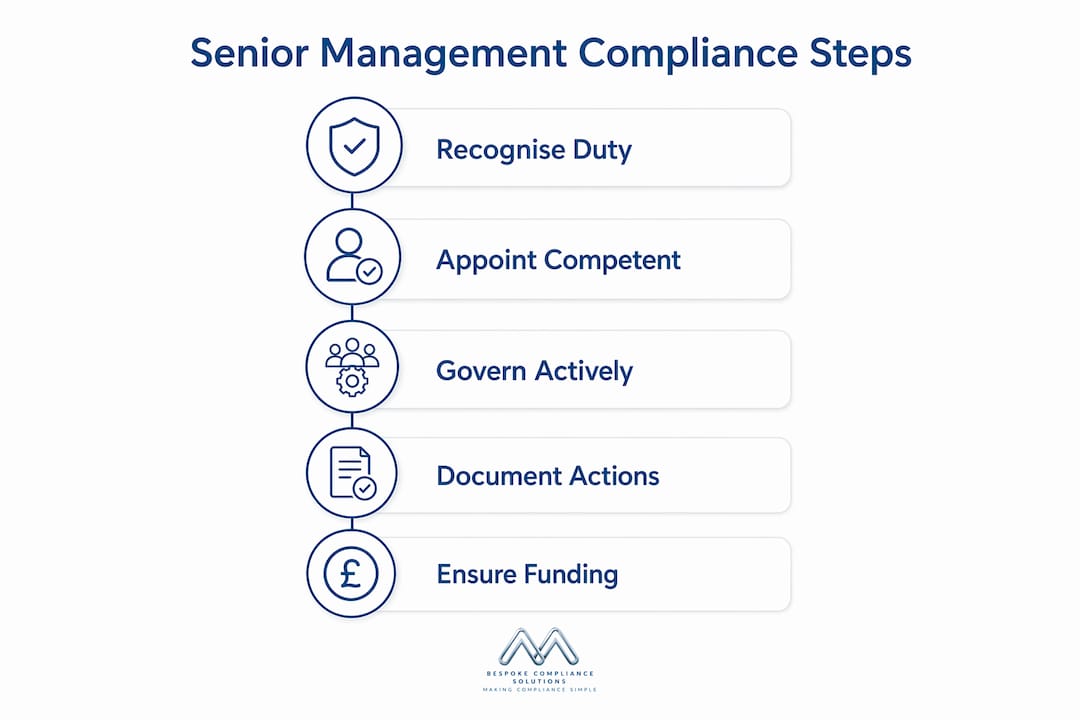
Your core responsibilities as a senior leader in water compliance include:
Appointing and supporting a Responsible Person (Water) with the authority and resources to act
Establishing a governance framework that embeds water safety into organisational risk management
Allocating sufficient budget and staffing to maintain a functioning Water Safety Management System (WMS)
Actively monitoring compliance rather than simply receiving reports
Ensuring risk assessments are current, site-specific, and reviewed at defined intervals
Maintaining documented evidence of your oversight, which forms the basis of any statutory defence
Escalating failures promptly and ensuring corrective actions are tracked to completion
Passive oversight is no longer defensible. The shift from corporate liability to individual accountability means your name, not just your organisation’s, is on the line.
What does the legal framework require of senior management in UK water compliance?
The regulatory architecture governing water compliance in the UK draws from several interlocking pieces of legislation, each placing duties squarely on senior leaders.
The Health and Safety at Work etc. Act 1974 requires employers to manage risks to health, including those arising from Legionella bacteria in water systems. The Water Industry Act 1991 sets out the statutory duties of water undertakers, with section 94 obligations requiring companies to maintain effective systems. The Water (Special Measures) Act 2025 goes further still, introducing personal criminal liability for senior executives where environmental mismanagement causes harm.
Under the Companies Act 2006, directors owe a duty to promote the company’s success and to exercise reasonable care, skill, and diligence. The Water (Special Measures) Act 2025 raises the bar by establishing that environmental non-compliance can constitute a breach of those statutory duties, particularly where directors fail to act on regulatory warnings or internal audit findings.
Key statutory duties for senior managers include:
Exercising due diligence in the supervision of water safety systems and personnel
Acting on regulatory warnings, audit findings, and internal escalation reports
Submitting accurate compliance certifications and approving pollution incident reduction plans personally
Ensuring the board receives unfiltered, timely information on compliance performance
Cooperating with Ofwat, the Environment Agency, and the Health and Safety Executive (HSE) during investigations
The HSE’s Approved Code of Practice L8 and Technical Guidance HSG274 set the operational standards for Legionella control. Failure to follow them does not automatically constitute a criminal offence, but it makes it very difficult to demonstrate the due diligence a court or regulator will expect.
Who does what? Duty Holder, Responsible Person, Authorised Person, and Competent Person explained
Four distinct roles underpin water safety governance in UK organisations. Senior management must understand each one, appoint the right people, and hold them accountable.
Duty Holder: The organisation or individual with overall legal accountability for water safety. In most cases this is the employer, building owner, or person in control of premises. The Duty Holder cannot delegate away their legal liability, only the operational tasks.
Responsible Person (Water): Appointed by the Duty Holder to implement and manage the water safety control programme day to day. They must have sufficient authority, knowledge, and resources to act. This role is often held by a facilities manager or a specialist contractor.
Authorised Person (Water): A technically competent individual authorised to carry out or oversee specific water safety tasks, such as system disinfections or temperature monitoring. They operate within a defined scope of authority set by the Responsible Person.
Competent Person (Water): Someone with the training, experience, and knowledge to carry out specific tasks safely and correctly. Competence is task-specific and must be verified, not assumed.
Role | Primary accountability | Appointed by | Key function |
Duty Holder | Legal and organisational | Statutory (employer/owner) | Ultimate accountability |
Responsible Person (Water) | Operational management | Duty Holder | Implements control programme |
Authorised Person (Water) | Technical oversight | Responsible Person | Authorises specific tasks |
Competent Person (Water) | Task execution | Responsible Person | Carries out defined activities |
Senior management’s job is not to fill these roles personally, but to appoint the right people, verify their competence, and create the conditions for them to succeed. A compliance manager’s responsibilities in water hygiene overlap significantly with the Responsible Person role, and understanding that overlap helps boards hold the right people to account.
Training and competence sit at the heart of this structure. Appointing someone as Responsible Person without verifying their qualifications, or failing to fund their continuing professional development, undermines the entire governance chain. Legionella awareness training is not optional for those in these roles.
How should senior management govern and oversee water compliance on an ongoing basis?
Good governance in water compliance does not happen by accident. Regulators expect boards to have standing agenda items on water compliance, with clear escalation routes to executive teams that do not filter or soften risks before they reach the top.
The practical governance steps senior leaders should embed include:
Making water compliance a fixed item at board and senior leadership meetings, with documented minutes
Requiring the Responsible Person to report directly to a named board member or executive
Reviewing the Water Safety Management System at least annually, and after any significant incident or system change
Commissioning independent audits of the WMS, separate from internal self-assessments
Tracking corrective actions from risk assessments and audits through to verified completion
Allocating a defined budget line for water hygiene activities, reviewed annually against risk
Reviewing risk assessments whenever premises change, occupancy changes, or new water systems are installed
Effective boards do not simply receive compliance reports. Boards must actively question and challenge the data they receive to meet due diligence standards. If a report says everything is fine, the right question is: how do we know? What was tested, when, and by whom?
Pro Tip: Keep a contemporaneous record of every board discussion on water compliance, including the questions asked and the answers given. If a regulator or court ever scrutinises your oversight, those minutes are your evidence. A board that asks hard questions and documents them is in a fundamentally stronger position than one that nods through a clean report.

A water compliance action tracker gives senior managers a practical way to record, assign, and evidence corrective actions across multiple sites. Paired with a structured audit checklist, it creates the paper trail that regulators and courts look for when assessing whether oversight was genuine.
Resource allocation deserves particular attention. Underfunding water safety programmes is one of the most common governance failures identified in regulatory investigations. Budget decisions made at board level directly affect whether the Responsible Person can do their job.
What are the legal consequences of non-compliance, and how does the Water (Special Measures) Act 2025 affect you personally?
The Water (Special Measures) Act 2025 marks a structural shift in how UK law treats executive accountability for water and environmental failures. For the first time, senior managers face individual criminal prosecution for environmental mismanagement, not just corporate fines.
The key implications for senior leaders are:
Personal criminal liability: Where pollution incidents cause significant ecological damage and senior managers failed to exercise due diligence, they face prosecution under the new offence of “Environmental Mismanagement Causing Harm,” carrying up to five years’ imprisonment and unlimited fines.
Bonus prohibition orders: Ofwat can ban bonuses for directors and senior executives of undertakers found to be materially and systematically noncompliant with environmental permit conditions.
Director disqualification: Chief executives who fail to comply with Pollution Incident Reduction Plan (PIRP) requirements face potential disqualification proceedings alongside unlimited fines.
Section 19 undertakings: Where compliance fails, Ofwat’s section 19 powers enforce governance and management reforms, not just technical fixes, reflecting that oversight failures drive non-compliance.
Breach of director duties: Under the Companies Act 2006, ignoring regulatory warnings or audit findings can now constitute a breach of the statutory duty to exercise reasonable care and diligence.
The statutory defence available to chief executives under the Water Industry Act 1991 requires them to prove they took all reasonable steps and exercised all due diligence to secure compliance. Critically, this defence depends on contemporaneous evidence of active, hands-on oversight rather than passive delegation. A CEO who can point only to annual board reports will struggle to satisfy that test.
The shift from corporate to individual accountability is deliberate. Legislation now forces boards to embed water and environmental compliance directly into risk management frameworks, remuneration structures, and annual reporting. Treating water compliance as a purely technical matter, handled somewhere below board level, is no longer a viable position.
Key takeaways
Senior management’s role in water compliance is a direct legal duty requiring active oversight, documented governance, and personal accountability under UK law as of 2025.
Point | Details |
Personal liability is real | The Water (Special Measures) Act 2025 introduces criminal prosecution and unlimited fines for senior managers who fail due diligence. |
Four roles must be clearly defined | Duty Holder, Responsible Person, Authorised Person, and Competent Person each carry distinct accountability that boards must actively support. |
Passive oversight is not a defence | A statutory defence requires contemporaneous, audited evidence of active personal oversight, not just receipt of reports. |
Governance must be documented | Board minutes, action trackers, and audit records form the evidential basis regulators and courts will examine. |
Bonus prohibition orders are live | Ofwat can ban executive bonuses for directors and senior executives found to be materially and systematically non-compliant with environmental permit conditions under the Water (Special Measures) Act 2025. |
How Bespokecompliancesolutions supports senior managers in meeting their duties

Bespokecompliancesolutions works directly with senior managers and duty holders across commercial, healthcare, housing, and facilities management sectors to make water compliance straightforward and defensible. From bespoke Legionella risk assessments and water sampling through to logbook implementation and ongoing consultancy, every service is tailored to your organisation’s specific sites and risk profile.
If you are responsible for water hygiene compliance and want to be confident your governance holds up to scrutiny, get in touch with Bespokecompliancesolutions today.
Recommended
Comments