
The role of insurance in water compliance: 2026 guide

Insurance is a financial safeguard in water compliance, not a substitute for operational controls. Environmental Impairment Liability (EIL) policies cover water-related incidents up to defined caps, but standard breaches alone can cost between £50,000 and £500,000, with rare events reaching £500 million. That gap matters. The role of insurance in water compliance is to sit alongside documented risk management, not replace it. Businesses in commercial and healthcare sectors that treat insurance as their primary defence leave themselves exposed to exclusions, claim denials, and regulatory penalties that no policy will cover.
How does insurance complement water compliance and risk management?
Insurance acts as a financial backstop when water-related incidents occur despite best efforts. It does not remove the need for rigorous water risk assessment, documented control plans, or regulatory compliance. Insurers know this, and they price policies accordingly.

A well-structured water compliance programme gives insurers confidence that known risks are being managed. Without that evidence, underwriters apply broader exclusions or decline cover altogether. Detailed, site-specific risk disclosures improve coverage adequacy and prevent the “operational blindness” that leaves businesses with gaps they only discover at the point of a claim.
The risks that insurance typically covers include sudden pollution events, accidental contamination, and third-party liability arising from water system failures. The risks it commonly excludes are equally telling:
Gradual pollution from slow-release contaminants
Known violations of regulatory standards at the time of policy inception
Legionella and bacterial contamination in systems without documented control plans
Mould arising from water ingress where maintenance records are absent
Pro Tip: Document every water system inspection, temperature check, and corrective action. Insurers treat a complete compliance record as evidence of managed risk, which directly influences both your premiums and the scope of your cover.
The importance of insurance for water management lies in this dynamic. A business that invests in Legionella risk management and maintains up-to-date records is not just meeting regulatory obligations. It is actively improving its insurability.
What are the common insurance exclusions in water-related risks?
Insurance exclusions in water-related policies are the single greatest source of unexpected financial exposure for compliance managers. Understanding them before a claim arises is the difference between recovery and ruin.
EIL policies and standard commercial property policies share a common set of exclusions. Industry experts advise that exclusions often include Legionella, bacteria, mould, and gradual pollution as the most frequent coverage traps. These are not obscure clauses. They are standard language that applies to the majority of commercial water systems.
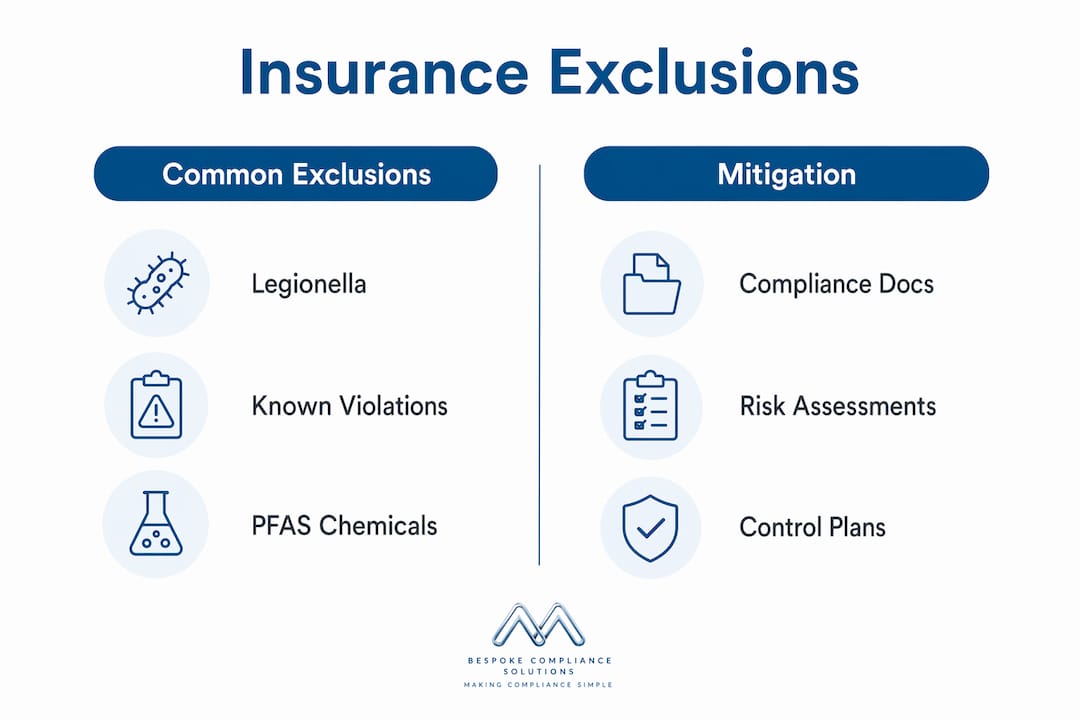
The emerging challenge is PFAS, a group of synthetic chemicals found in industrial and firefighting water systems. Insurance markets are narrowing coverage for PFAS contamination, pushing businesses towards risk retention rather than risk transfer. That shift has significant financial disclosure implications for any organisation operating near industrial water sources.
The financial stakes are clear. EIL policies cap coverage between £50 million and £250 million, but fat-tail pollution events can reach £500 million. A policy cap is not a safety net if the event exceeds it. Businesses that assume their EIL policy covers all scenarios have not read the exclusions carefully enough.
Strong compliance documentation can mitigate some exclusions. Insurers treat control plans and compliance records as evidence that known risks are being managed, which can reduce the scope of exclusions applied at underwriting. The logic is straightforward: a business that proves it controls Legionella risk is less likely to face a Legionella exclusion than one that cannot demonstrate any control at all.
What strategies align insurance with water compliance to reduce risk and costs?
Aligning insurance with water compliance requires a deliberate approach. The following steps give compliance managers a practical framework.
Commission a water risk assessment and refresh it every 24 months. An up-to-date assessment is often a formal requirement for industrial property insurance. Assessments older than 24 months can trigger exclusions or outright claim denials. A thorough assessment costs around £20,000 but can prevent claim exclusions or damages exceeding £500,000.
Integrate operational controls into your compliance documentation. Pumping restrictions, temperature monitoring, and disinfection records all form part of the evidence base that insurers review. Combining pumping restrictions with insurance tools can reduce groundwater withdrawals by up to 19.9% during drought conditions, while insurance buffers profit losses by nearly 50%. That is a measurable return on compliance investment.
Negotiate for policies with fewer exclusions, not simply higher limits. Finding insurance with fewer exclusions is more effective than seeking high policy limits. A £10 million policy with no Legionella exclusion protects you better than a £50 million policy that excludes bacterial contamination entirely.
Consider professional liability and pollution liability coverages separately. Standard commercial policies rarely cover water treatment programme failures. Pollution liability policies fill that gap for businesses operating cooling towers, hot water systems, or industrial process water.
Review your risk assessment before each renewal. Insurers increasingly request current compliance documentation at renewal. Presenting a reviewed Legionella risk assessment gives underwriters the evidence they need to price your risk accurately rather than applying blanket exclusions.
Pro Tip: Ask your insurer to specify exactly which exclusions apply to your water systems before you sign. Vague policy language on “gradual pollution” or “known conditions” can void cover for the very incidents you are most likely to face.
Strategy | Primary benefit | Key metric |
Water risk assessment (refreshed every 24 months) | Maintains insurance eligibility | Prevents claims exceeding £500,000 |
Documented control plans | Reduces exclusion scope at underwriting | Supports insurer confidence |
Fewer exclusions over higher limits | Closes coverage gaps | Protects against bacterial and pollution claims |
Pollution liability cover | Fills gaps in standard commercial policies | Covers water treatment programme failures |
How are evolving water regulations changing insurance in 2026?
Water regulation is shifting financial risk back to businesses in ways that most compliance managers have not fully priced in. Water utilities are repricing supply risk and transferring shortage exposure directly to industrial users. Businesses that relied on utilities to absorb supply risk now face that exposure on their own balance sheets.
The insurance market is responding to this shift with tighter underwriting. Key changes in 2026 include:
Narrowing coverage for PFAS and other emerging contaminants across EIL and commercial policies
Increased financial disclosure requirements linked to water-related regulatory compliance
Greater scrutiny of Legionella and bacterial risk documentation at policy inception and renewal
Regulatory pressure in UK and EU contexts for transparent, auditable water management systems
“Increasing insurance exclusions in emerging contaminants necessitate a shift from risk transfer to risk retention in corporate water risk strategies. Businesses that have not built internal risk retention capacity will find themselves uninsured for the very risks most likely to materialise.”
The practical implication is that water compliance strategies must now account for the insurance market’s direction, not just current regulatory requirements. A business that meets today’s standards but ignores PFAS documentation or lacks a current water risk assessment will face narrowing cover options at its next renewal. Transparent water management systems are no longer just a regulatory nicety. They are a prerequisite for maintaining insurability.
Key takeaways
Insurance in water compliance works only when paired with documented risk management, current assessments, and operational controls that satisfy insurer requirements.
Point | Details |
Insurance is a backstop, not a shield | Policies exclude known violations, Legionella, and gradual pollution without documented controls. |
Refresh assessments every 24 months | Assessments older than 24 months risk triggering exclusions or claim denials at renewal. |
Fewer exclusions beat higher limits | A policy with no bacterial exclusion protects more than a high-limit policy that excludes Legionella. |
PFAS is reshaping the market | Narrowing PFAS coverage is pushing businesses from risk transfer towards risk retention. |
Documentation drives insurability | Site-specific compliance records reduce operational blindness and improve coverage adequacy. |
Insurance and compliance: what I have learned working in water risk
The businesses that get into trouble with insurance are rarely the ones that ignored compliance entirely. They are the ones that did just enough to satisfy a tick-box audit and assumed their policy would cover the rest. That assumption fails at the worst possible moment.
What I have seen consistently is that insurers are not adversaries. They respond to evidence. A business that presents a current water risk assessment, a maintained logbook, and a documented control programme gives an underwriter something concrete to work with. The result is fewer exclusions, more accurate pricing, and cover that actually holds up when a claim is made.
The PFAS situation is a warning that compliance managers should take seriously now, not at the next renewal. The market is moving faster than most organisations are tracking. Businesses that have not audited their water systems for emerging contaminants will find themselves in a retention position they did not choose.
My strongest advice is to treat your compliance documentation as an insurance asset, not just a regulatory obligation. Every temperature log, every disinfection record, and every risk assessment update is evidence that your risk is managed. Insurers price managed risk differently from unmanaged risk. That difference shows up directly in your premiums and in whether your claim is paid.
— Sammi
Water compliance support from Bespokecompliancesolutions
Bespokecompliancesolutions works with commercial and healthcare organisations across the UK to deliver Legionella risk assessments and water hygiene compliance programmes that satisfy both regulatory and insurance requirements. Every service is built around your site’s specific conditions, not a generic template.
From water sampling and analysis to bespoke logbook systems and ongoing consultancy, Bespokecompliancesolutions gives you the documented evidence base that insurers and regulators require. Healthcare premises managers can also access sector-specific compliance services designed around the particular risks of clinical water systems. Contact Bespokecompliancesolutions to discuss a compliance programme that protects your organisation and supports your insurance position.
FAQ
What is the role of insurance in water compliance?
Insurance provides financial protection against water-related incidents but requires documented compliance controls to remain valid. Without current risk assessments and operational records, insurers apply exclusions that void cover for the most common water risks.
Does insurance cover Legionella contamination?
Standard commercial policies frequently exclude Legionella unless the business can demonstrate a documented control plan. Policies with fewer exclusions and evidence of active Legionella management offer the most reliable cover.
How often must a water risk assessment be refreshed for insurance purposes?
Insurers typically require a water risk assessment no older than 24 months. An out-of-date assessment can trigger exclusions or result in a claim denial at the point of an incident.
What are PFAS and why do they affect insurance coverage?
PFAS are synthetic chemicals found in industrial and firefighting water systems. Insurance markets are narrowing coverage for PFAS contamination, which means businesses with PFAS exposure must increasingly retain that risk on their own balance sheets rather than transferring it to an insurer.
How does compliance documentation affect insurance premiums?
Detailed, site-specific compliance records reduce the “operational blindness” that leads underwriters to apply broad exclusions. Businesses with thorough documentation typically receive more accurate pricing and fewer exclusions than those without it.
Recommended
Comments